Unlike other Indian cities, Varanasi offers amazing excitements and challenges to tourists. First visit: 24 December 2004. Second visit: 6 January 2010
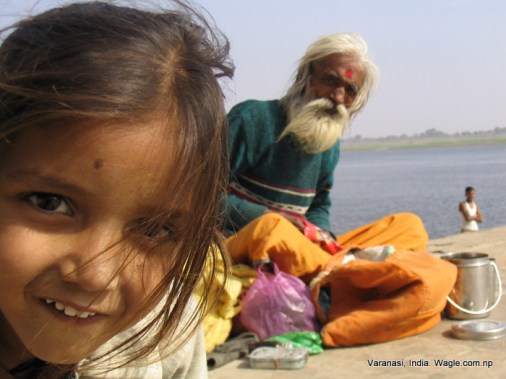
A peek into their eyes: At a Ganga ghat in Varanasi.
My visit to Varanasi five years ago was first in many aspects. That was my first India trip, my first visit to any city outside Nepal. That was my first encounter with the Indian crowd, the intense and chaotic city life that can’t be seen in Nepal. Most of the things appeared to be larger and louder. The river Ganges seemed to be slightly bigger than the Indian Ocean of my imagination. I hadn’t seen the sea.
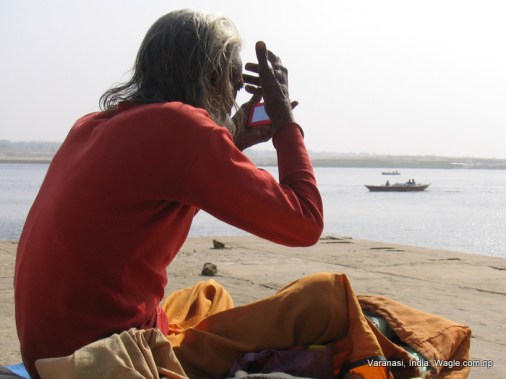
Make-up: A Sadhu makes himself ready for the day in one of the Ghats of Ganges
By the time I visited the city second time last week, I had seen some of the world’s largest cities, seas and traveled virtually the length and breadth of India. The city of Varanasi was same except that, to set the record straight, the river Ganges was slightly smaller than the sea. I wasn’t as stunned this time to see the crowd in the streets of Varanasi. Instead, I was tempted to compare the scene with the one that I had seen a couple of months ago in MG Road, Calcutta, where, I feel, one can truly experience THE India that was once servant to the British colonialists, and is crowded, laborious and carries with it some of the visible remnants of colonialism. With continuous and deafening honking Varanasi streets are so dirty and mismanaged, even by the standards of Kathmandu, let alone New Delhi where I have been living for the past one year.
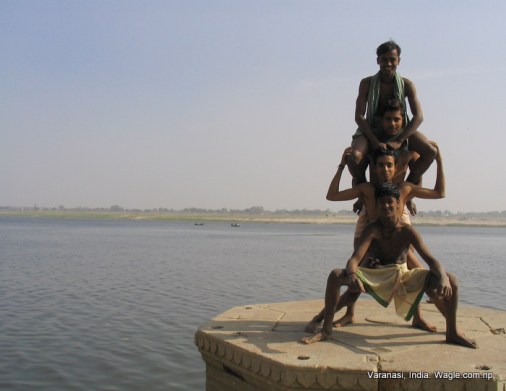
Human Tower: These kids spontenaously posed for my camera as I was taking a walk in the Ghats. As soon as they say me with camera, they said: "Hello, sir, take our photo." (another pic)
Despite all that a solid fact remains immortal that Vanarasi offers something unique and amazing amidst its seemingly rowdy streets and anarchic crowds: the breathtaking ghats (riverbank), the labyrinth of gallis (alleys) and river Ganga (Ganges) that offers drops of salvation to millions of Hindus around the world. The fact that people intentionally come here, in the city and at the ghats, to die doesn’t make it a place of suicide. People who seek mokshya want to die a natural death, not the forced one. The Nepal-government run women-only bridhashram (old-age home) was packed to its capacity, I was told, like it was five years ago. I didn’t talk to the ladies this time but I had in my last visit. “Nowhere in the world is a better place to die than this,” one of them had said as others nodded in agreement. To purposely wait to die might be the easiest way to undermine the importance of one’s own life but that is what our fatalistic Hindu tradition teaches us even now. It doesn’t encourage us to achieve success in life but to attain mokshya in death.
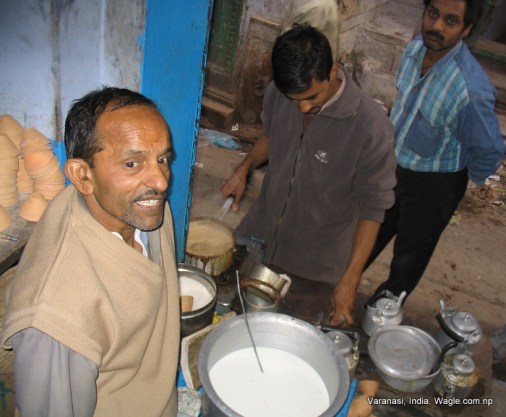
Chai: A lot of tea is consumed during the winter in India
For a Westerner (that includes a growing number of atheist Chinese tourists) every single bit of activity that happens in and around the ghats of Ganges is fascinating. Through them, in part, the world makes the image of India. The scenes of devotees openly bathing and washing clothes, the Yogis wandering around or posing for cameras, the stray cows roaming in the streets along side the cycle-rickshaws, horse-carts and cars, and people eating and peeing next to each other right on the busy streets are awe-striking.
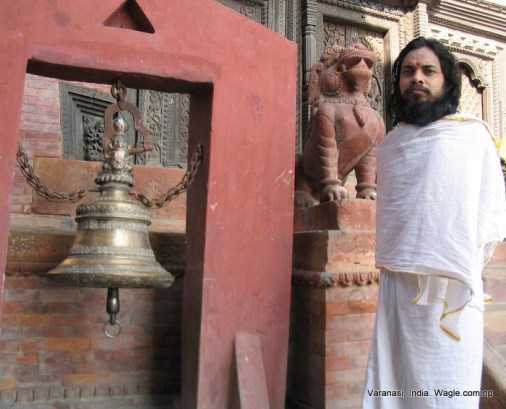
Bell and a priest: A Nepali priest stands aside a bell at the replica of Pashupatinath Temple in Lalita Ghat, Ganges. The temple is popular by the name of Nepali Mandir/Temple in the city.
For many Nepalis, Vanarasi or Banaras is a place of learning too though the prominence of the place as an educational hub for Nepalis has diminished over the years thanks to the new education policy in Nepal that encourages private participation in education. There are still a few Nepali students who have been studying Sanskrit and other subjects like music and medicine in universities here. My purpose wasn’t educational. I backpacked then and I backpacked this time with Lonely Planet travel guide in hand. I don’t know how it feels like to stay in a five-star hotel, go around the city in a fully-guided tour and remain oblivious about the intensity of the street life. (I wouldn’t prefer that for any new city though, if opportunity comes, wouldn’t mind going for the same for Varanasi!) It demands a lot of energy in a traveler to self-manage the trip, to haggle for the prices of hotel rooms and the rickshaw ride and to make a decision about the various offers that come across while walking.
Waiting for death: These women from different parts of Nepal were living in an old-age home where, they said, they were waiting to die in Kashi. This time, though, I didn't go to see them. (I'll post a story I wrote based on my conversation with them five years ago in the next few days.)
Most of the intense activities in Varanasi are centered on the ghatsand the dense neighborhood/market near them though the city is spread quite far and wide. Rest of the city is just like any other small Indian town with chaotic traffic, family-run shops and newly opened outlets of Western brands. Like I did in my last visit, I largely remained in what is called the Old City where finding the correct alley to reach the destination (bazaar or the ghats) becomes a challenge. I was lost several times in the maze of gallis last time.
Would I live in a city like Varanasi? No. Did I enjoy my trips to the city? Yes. Would I like to go there again? Certainly.
A singer at the ghat: Dharmananda Budhathoki, a Nepali student of music at Banaras Hindu University used to sing at the aarti ceremony while other Nepali boys (students at Sanskrit schools and colleges in Kashi) performed the aarti at the Dashaswomedha Ghat. Hundreds of locals and tourists go to see the aarti every evening. When I reached at the venue this time, I didn't see Budhathoki. He has gone back to Nepal since then and started the similar aarti at the bank of Bagmati river in Pashupatinath temple complex in Kathmandu. I didn't talk to the current singer, also a Nepali as I was told by a boy- another Nepali- who performed the aarti. Seven boys- at least five of them Nepalis- perform the aarti.
Here are more photos. All from my previous trip. But Varanasi hasn’t changed much.
I am not sure if he’s still there. Here’s the caption I wrote 5 years ago: Srikrishna Awasthhi, who has been selling paan for the past 54 years, has served with his paan to almost all Nepalis who come here. Dudhvinayak is the place where Nepali dharmashala is situated and many Nepalis live in the neighborhood.
I stayed in a Nepali Dharmashala last time. One of the colorful gates of the Dharmashala.
Saw these kids playing on rooftop
It’s rare to have a clear view of sky from the old part of the Varanasi city unless you are at the ghats
Cow mother, as they are called in Hindu belief, can be seen everywhere in Varanasi streets
An elderly man awaits his cup of tea near Nepali dharmashala in one of those alleys in Varanasi’s Old City. When I was there last time (2004 Dec), the Tsunami had hit many Asian costal cities including some in India.
Aarti at Dashashwamedha ghat. I also saw another aarti at another ghat near Lalilta ghat this time.
Nepali students perform aarti at Dashashwomedha ghat every evening.
Crowd is the halmark of Vanarasi
Pepsi and Coke have reached even in the darkest of the alleys
A boy gives his dad time to rest as he assumes duty at his shop.
Folks wait for their cups of tea in varanasi
I get the taste of tea in matka (mud-glass) that is also called kulhad. I was fascinated when I first drank tea in kulhad. This is eco-friendly and provides jobs to many Indians. The Indian Railways, one of the premier markets for tea/chai, rarely uses such cups these days. I saw many tea-shops in Varanasi this time too that sold tea in such cups.
No wonder, Varanasi is considered the world’s oldest city
Street of Vanarasi
I am not sure if she is still living in the old-age home but when I met her in Dec 2004, she said she had come to Kashi just to die
Firewoods to burn corpses in a Ghat. I learnt in the recent visit that there are two Ghats for burning. I saw both of them this time.
Official notices discourage people to use soap while bathing and washing at the Ghats but a lot of people ignore.
Ghats are animated
Parents, I feel, should teach their kids to be optimistic to their lives, not be fatalistic as Hindu belief wants us to be
In a stark contrast to the bustling city life, Ghats are peaceful
Ghats also offer people some space to reflect upon their own lives
It’s a season of kites in Varanasi. A lot of boys could be seen running after the falling kites.
The lebyrinth of galli in Varanasi comes as a challenge to first time visitor of the city. I was lost in one of the alleys last time.
A monkey passes by a mosque in the Old City, Varanasi. The most important Vishwanath temple of Varanasi, Old City, was replaced by a mosque during the Mugal times. Now both temple and mosque stand side by side amidst a tight security. But this is not the mosque near the Vishawanath temple but nevertheless signifies how Muslim invaders destroyed the structures of different faith and built mosque in those places or near them.
Can’t believe I am still wearing some of those clothes
A Sadhu makes himself ready for the day in one of the Ghats of Ganges
At a Ganga ghat in Varanasi.
These kids spontenaously posed for my camera as I was taking a walk in the Ghats. As soon as they say me with camera, they said: “Hello, sir, take our pictures.”
These women from different parts of Nepal were living in an old-age home where, they said, they were waiting to die in Kashi. This time, though, I didn’t go to see them.
A Nepali priest stands aside a bell at the replica of Pashupatinath Temple in Lalita Ghat, Ganges. The temple is popular by the name of Nepali Mandir/Temple in the city.
A lot of chai is consumed during the winter in India
Dharmananda Budhathoki, a Nepali student of music at Banaras Hindu University used to sing at the aarti ceremony while other Nepali boys (students at Sanskrit schools and colleges in Kashi) performed the aarti at the Dashaswomedha Ghat. Hundreds of locals and tourists go to see the aarti every evening. When I reached at the venue this time, I didn’t see Budhathoki. He has gone back to Nepal since then and started the similar aarti at the bank of Bagmati river in Pashupatinath temple complex in Kathmandu. I didn’t talk to the current singer, also a Nepali as I was told by a boy- another Nepali- who performed the aarti. Seven boys- at least five of them Nepalis- perform the aarti.
……………..To purposely wait to die might be the easiest way to undermine the importance of one’s own life but that is what our fatalistic Hindu tradition teaches us even now. It doesn’t encourage us to achieve success in life but to attain mokshya in death. Well said !
Manoj Sharma
Ke hi chutecha
Banaras Hindu University, Varanasi. Destination of many students from Nepal. Desh phirera kehi garne students to aakhabhari sapana. Sweet Sita, reyazzing gana everyday. Dream of her is to open a music school at Nepal. Pardhan mantri banne haina natak ma Sunil Pokhrel jasto banne sapana.
300 bhanda pani badhi students chan banchan.


 Dinesh Wagle on Nepali Society
4 responses to “Varanasi: Five Years On”
nice post and great pictures. made me want to visit kashi even more, but definitely not to go wait for death though 😀
thank you! kashi is definitely a must-go place, not to die but to experience life 😛 highly recommended.
……………..To purposely wait to die might be the easiest way to undermine the importance of one’s own life but that is what our fatalistic Hindu tradition teaches us even now. It doesn’t encourage us to achieve success in life but to attain mokshya in death. Well said !
Ke hi chutecha
Banaras Hindu University, Varanasi. Destination of many students from Nepal. Desh phirera kehi garne students to aakhabhari sapana. Sweet Sita, reyazzing gana everyday. Dream of her is to open a music school at Nepal. Pardhan mantri banne haina natak ma Sunil Pokhrel jasto banne sapana.
300 bhanda pani badhi students chan banchan.