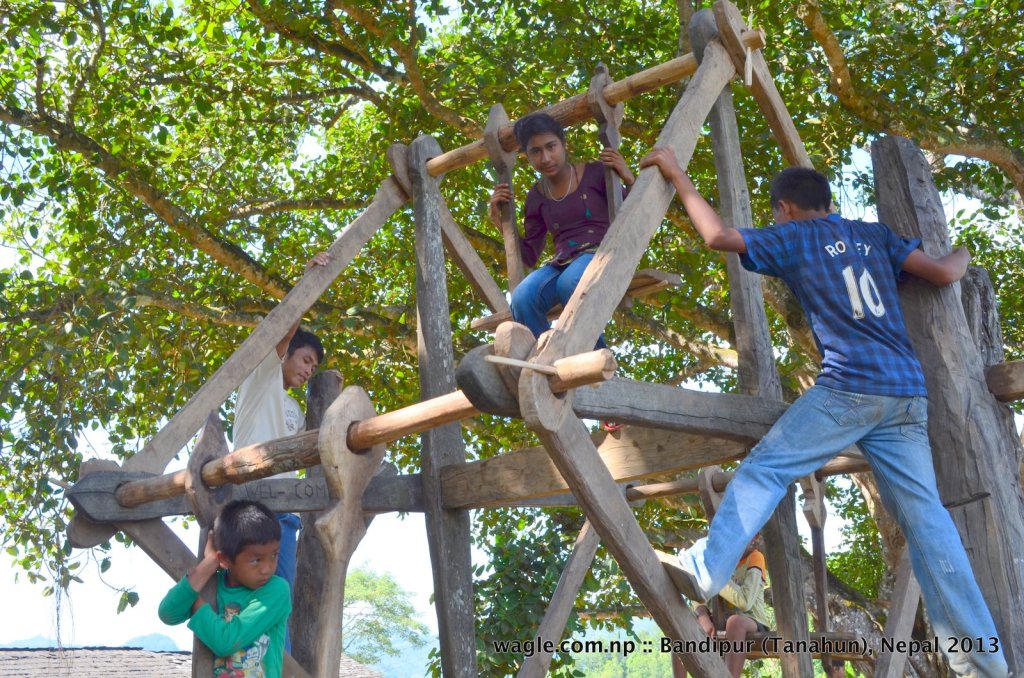
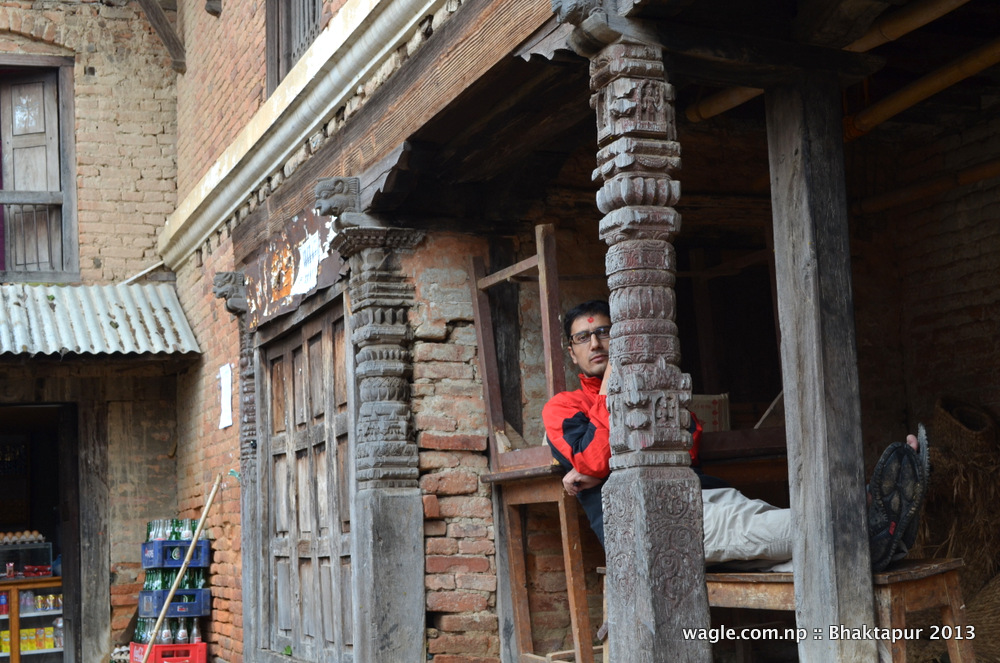
This trip happened during Dasain festival last October therefore the sights of pings (swings) of different types- linge, rote and jaanto. It was my second trip to Bandipur village that is located just above the highway that connects Pokhara with Kathmandu. Many find it beautiful but I have no such conclusive opinion about Bandipur. I thought new concrete buildings had damaged the authenticity of the village that still had some nice-looking traditional houses. A Bhaktapur Darbar Square-style ban on traffic on the main thoroughfare felt like a sensible thing to do. On a clear day the village offered a beautiful view of the Himalayas.
Linge ping: ‘Leaving Earth’ as they say and do during Dashain.
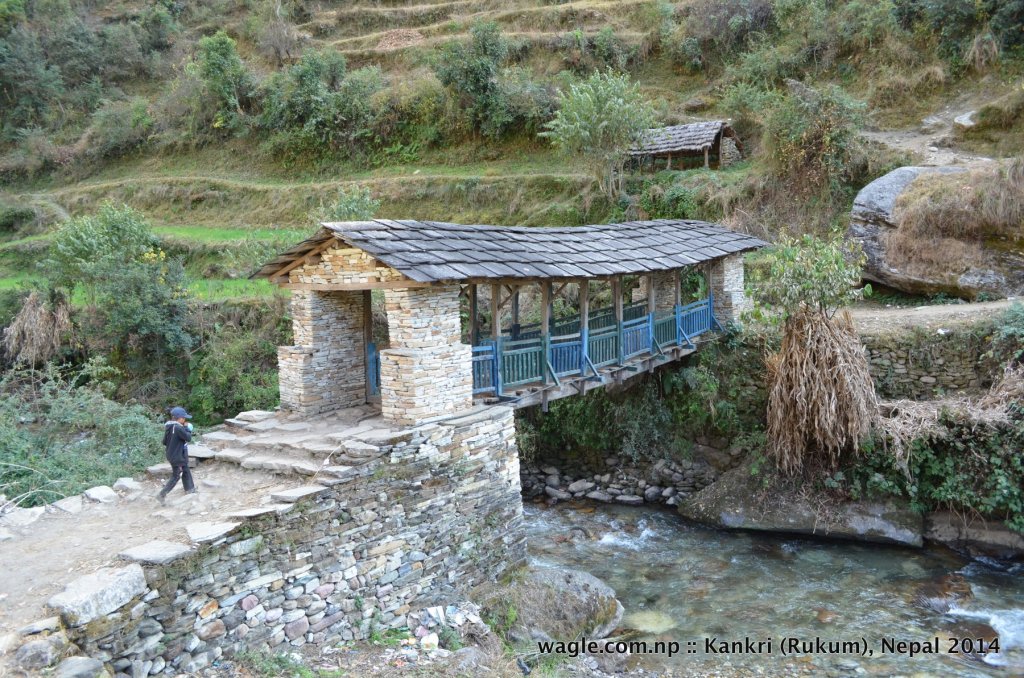
It took us four hours to reach Mahat village from Thabang village. It was mostly a pleasant walk on flat land (just a couple of small uphill and downhill) that followed the Thabang river.
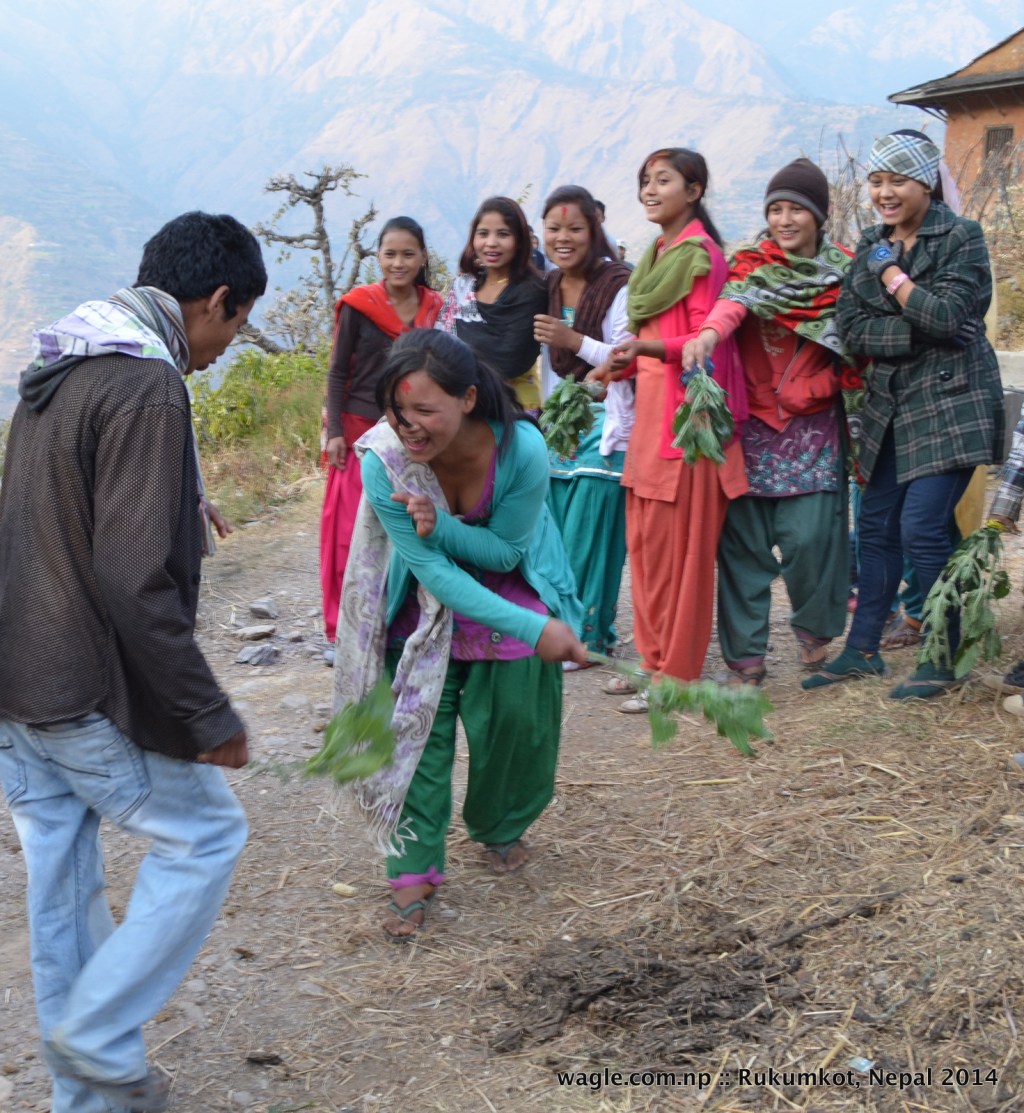
A day after Maghi there were no signs of colors in Rukumkot village. Instead, I was pleasantly surprised to see young boys and girls in Rukumkot hitting each other below the knees by stinging nettle. Dozens of boys and girls had gathered around the Village Development Committee building in the afternoon. Most of them held bunches of sisnu wrapped by pieces of paper or plastic to save their hands from sting.
Elderly people, mostly women, watched the teenagers play the game of sisnu. It was, like the game of colors in holi among youngsters, primarily a game between girls and boys– girls trying to attack boys and vice versa. The rule was that you couldn’t hit above the knees. I learned from the elders that the sisnu festival was a tradition in the village. Actually some women were surprised that I didn’t know about it. One of the girls hit me and an elderly woman, showing much sympathy, suggested me to massage my calves with ghee in the evening.
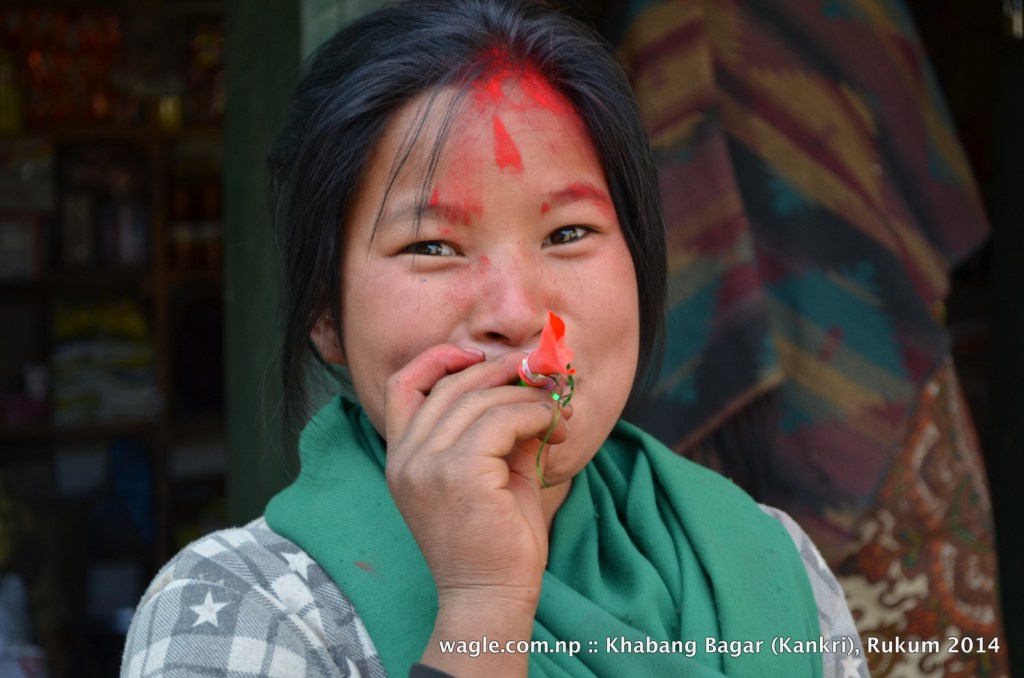
I saw that people in some villages of Rukum and Rolpa celebrated the Maghi festival like the way many in other parts of Nepal celebrate the Holi festival- by smearing their faces in colored powders. (See here how people of Thabang village celebrated.) A day after Maghi, after my return from Thabang, at Khabang Bagar a girl put abir (dye) on my forehead and jamara (barley sprouts) on my ear.
A girl tried to blow up a balloon in Khabang Bagar, Rukum where we stayed overnight before heading to Thabang, Rolpa.
Part of Holi-like ritual to celebrate Maghi festival
Women in Khabang Bagar
A man and women in Khabang Bagar shared a laugh after the man got his face smeared in colored powder by a girl (not seen in the photo)
Rukumkot; Kamal Pond behind bamboos
Two kids smiled at passengers of a car. Mt Sisne stood at the background.
Two peaks
Where Rukum is separated from Salyan
Embracing the “Ramri” (=beautiful; 4 KM). This in Salyan district.
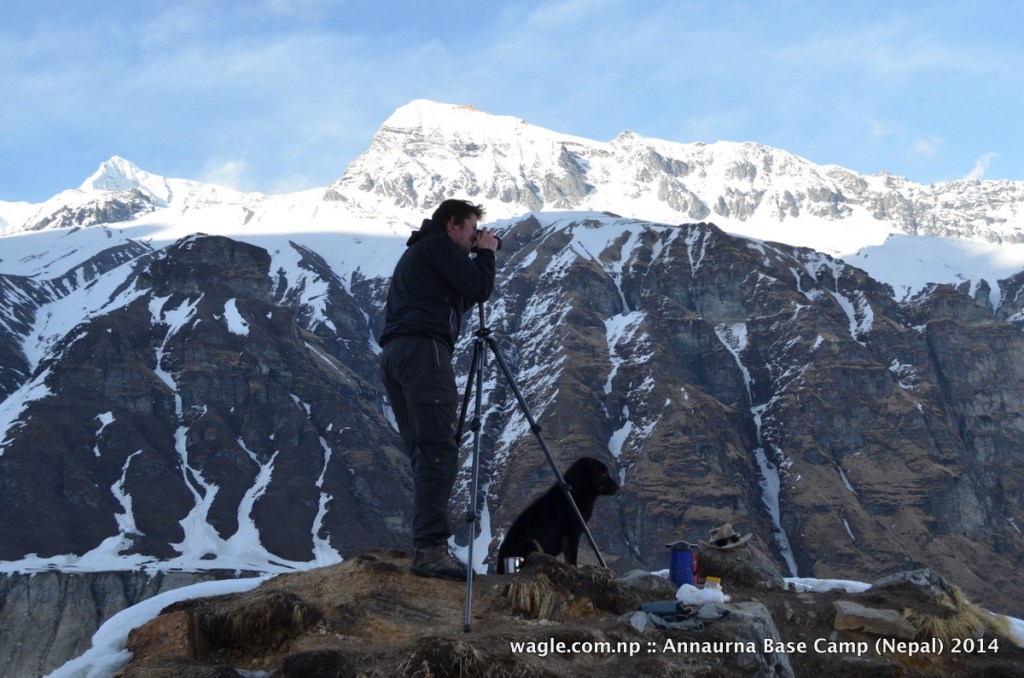
Tourists photographed Mt Machhapuchhre from the Annapurna Base Camp as the last rays of sun hit the summit in a recent evening.
I went to the base camps of two of the best-known mountains– the Annapurna South and the Machhapuchhre (also known as Mt Fish Tail)– for the first time last week (11-17 March). Here’s what I saw and felt.
A Himalayan bowl: At the Annapurna Base Camp (4,130m, ABC) I felt like I was in a huge bowl. There were snowy mountains on all sides- their heights ranging from 8091 m (Annapurna-I) to 5,663 (Tharpu Chuli aka Tent Peak). They didn’t look very far. The 360-degree view of the Himals was spectacular. Mornings and late afternoons offered some of the best and dramatic views of mountains. Around noon was super hot– so much so that I encountered a bare-chested foreign trekker as I was heading up to ABC from MBC (Machhapuchhre Base Camp). It looked as if he and a bare-armed woman in shorts who was walking behind him weren’t worried about being sunburned.
Around mid-day was the time to take nap and rest as the unforgiving sun made it almost impossible to walk around and watch the mountains. Moreover, I wasn’t feeling particularly well. I had a mild headache and caught cold. Fortunately signs of altitude sickness disappeared after a couple of hours of rest. I experienced the difficulties despite spending 22 hours at MBC (3700 m).
First Rays Of the New Rising Sun on the Mighty Annapurna: Sun caste its first rays of the day over the summit of 8091 m Annapurna I.Moon rose from the east as sun cast its last rays of the day over the summit of Mt Machhapuchhre
Weather conditions determine view in the Himalayas.Weather was fine when I was at ABC. Same was the case in Langtang when I was there in 2003. But lack of rhododendron flowers in the ABC trail was a big disappointment.
Keep your phone’s IMEI number safe. That could help you find your lost phone.
Five months ago I lost my dual SIM Android phone while traveling to Biratnagar from Ilam. I mourned the loss but continued my normal business with my other phone. But I wanted to get the phone back. And, a month ago I got it back.
I didn’t believe that Nepali police would be able to track and even recover my phone even if I provided them the IMEI number. But one day I found the phone box where IMEI number’s printed. (Dial *#06# or go to About Phone section to find your IMEI number and keep it safe. Also keep your receipt or the phone box safe.)
If you lose your phone and are in Kathmandu, go to Hanumandhoka. For those out of Kathmandu, go to district police office. Give them your IMEI number. (Android and iOS operating systems allow you to make your lost phone unusable but IMEI tracking helps retrieve your phone.)
Here I am withholding one crucial information that will determine whether your phone can be found. That’s because I don’t want thieves and people who find phone but don’t give that back to the owner to know this.
As for my phone, a guy in Jhapa had been using it for months. He had even put a plastic cover to protect the screen.
PS: If yours is a feature or smart phone, don’t just save your contacts in SIM card(s) or the phone. Sync them with your email or cloud account. My both phones were synced with my Google account which meant I didn’t have to worry about the contacts.
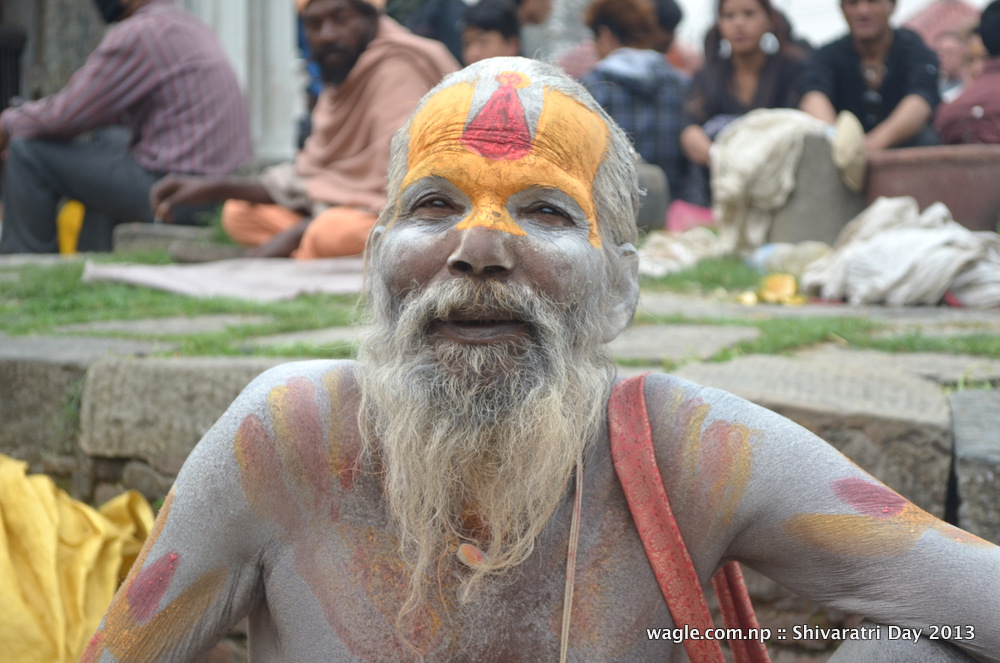
Didn’t go anywhere closer to the Pashupatinath temple or the weed-smoking yogis today but I know what it looks like on the day that leads to the great night of Lord Shiva (Maha Shivaratri). Here are some photos of me and the crowd from last year’s Shivaratri festival (taken by Suraj).
The Kathmandu Post celebrates its (and Kantipur’s) 21st anniversary today by publishing a 16-page pullout on Nepal’s social media scene. The supplement, titled “Platforms of Change“, explores how Nepalis are using the Internet and its various platforms mainly to express themselves and to connect and share and debate. In the lead article ‘Teleprinter to Twitter’, Editor-in-Chief Akhilesh Upadhyay talks about the impact of technological changes (and a constitutional provision that guaranteed press freedom) in impressive expansion of Nepal’s media.
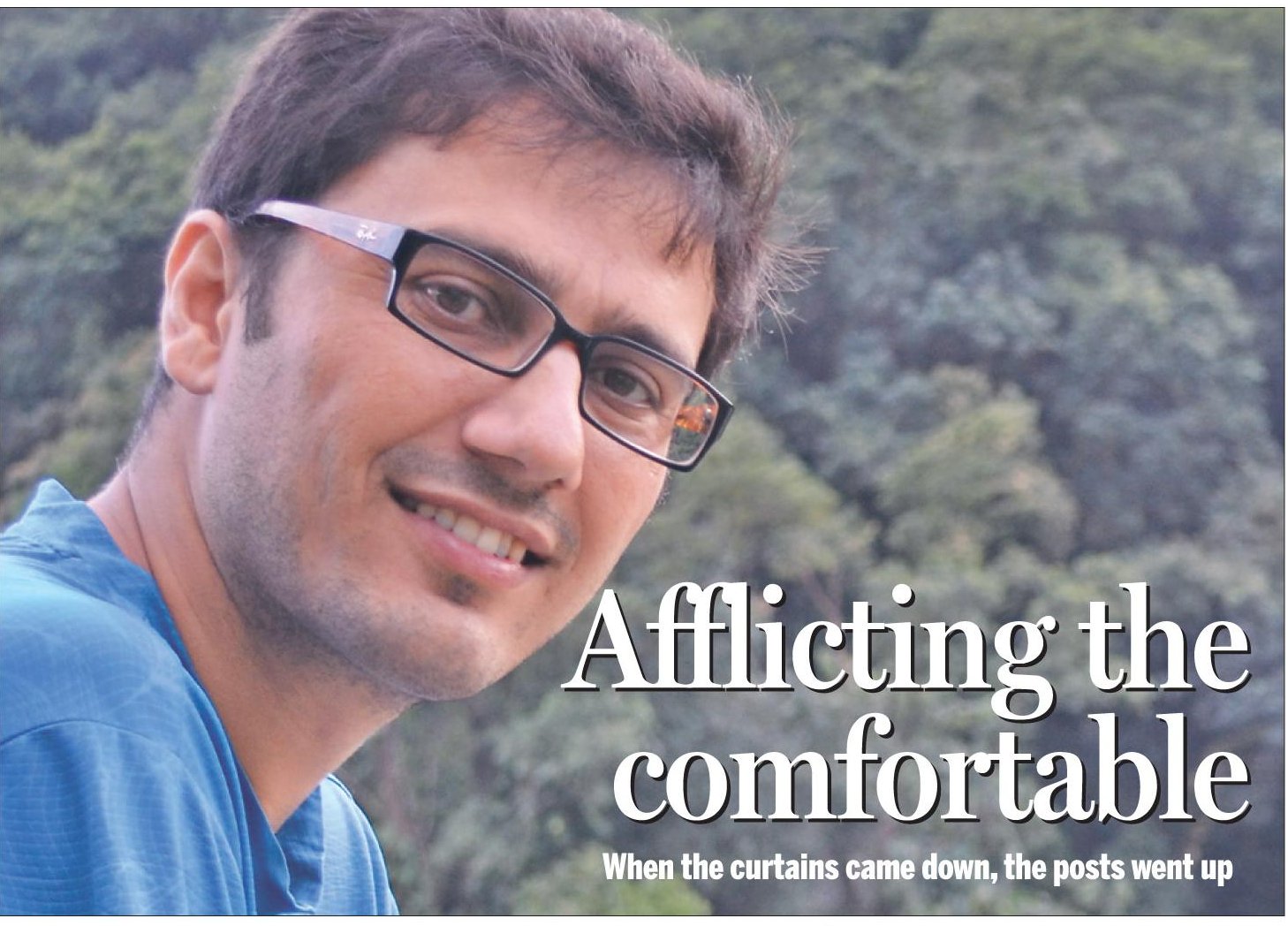
I was interviewed by the Post’s Weena Pun on my political blogging and journalism days.
Here’s the page as it appeared in the Post (PDF) and the following is the text:
When the then-king Gyanendra imposed his authoritarian rule in February 2005 and later clamped down on all private media outlets in Nepal, United We Blog became the go-to site for delivering uncensored political news. One of the two co-founders behind the blog, Dinesh Wagle, a former journalist with Kantipur daily, quit blogging for the site in 2012, after seven years of running it, but still blogs on his personal site. Wagle talked to the Post’s Weena Pun about his days as a journalist/blogger.
What is United We Blog?
It is a political blog—Nepal’s first—founded on my personal web domain in 2004. Initially it started as a forum to express private feelings and the daily grind lived by journalists and included stories by my friends Ujjwal Acharya and Deepak Adhikari and myself. Later, the site was hosted on blog.com.np and soon became the only uncensored source of political information in Nepal for a while in 2005.
Click on the photo to go to the article for background
Why did you decide to blog?
I was excited by the new medium of expression. In 2004, I had been a journalist with the mainstream media for seven years, and at that time, the new media was still very new in Nepal. Blogs were the ‘social media’ of that time. They provided additional and unlimited space for expressing ourselves, as opposed to limited print and air space of the old media. This ‘limitless’ space was the second reason for me to start a blog.
What has been the difference in your posts before and after the thenking Gyanendra clamped down on freedom of speech?
Before the royal coup in February 2005, our posts were mainly about what we did in our daily lives, whom we met and how we felt about the developments in our not-so-public lives. After Gyanendra imposed restrictions on freedom of expression, our blog posts became more political in nature and were aimed at challenging that stifling atmosphere and advocating for the restoration of democracy in Nepal. For us, freedom of expression and independent journalism became a mission. Soldiers patrolling newsrooms to impose censorship was a strange sight for us, and we expressed our dissent on our blog.
What is the difference between your work as a blogger and as a journalist? (धेरै…)
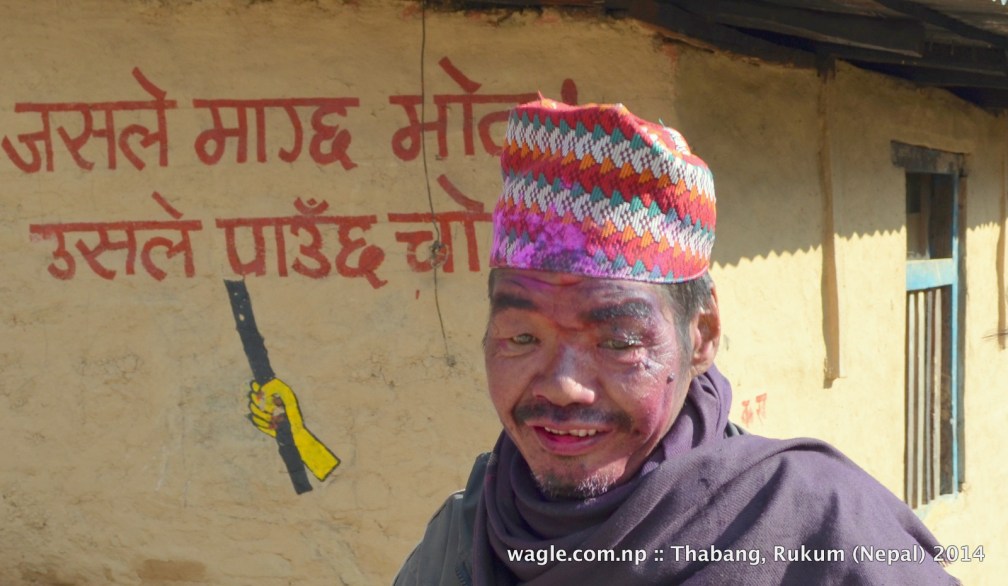
A man in Thabang, Rolpa, face smeared with colored powder, celebrated Maghi festival. On the background is an anti-election slogan- “the one who asks for vote will get chot (hurt).”
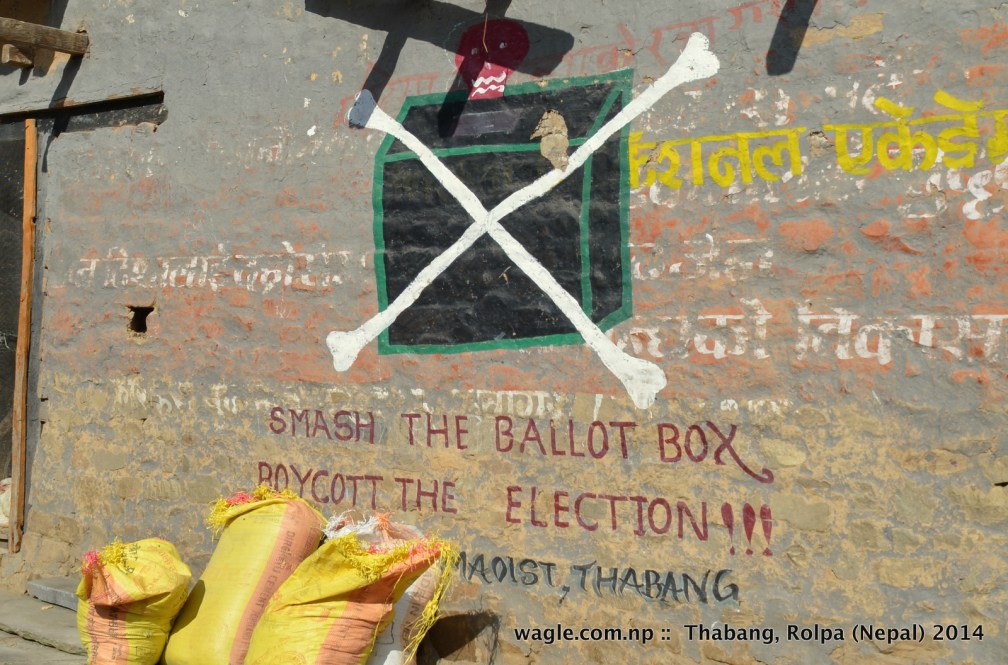
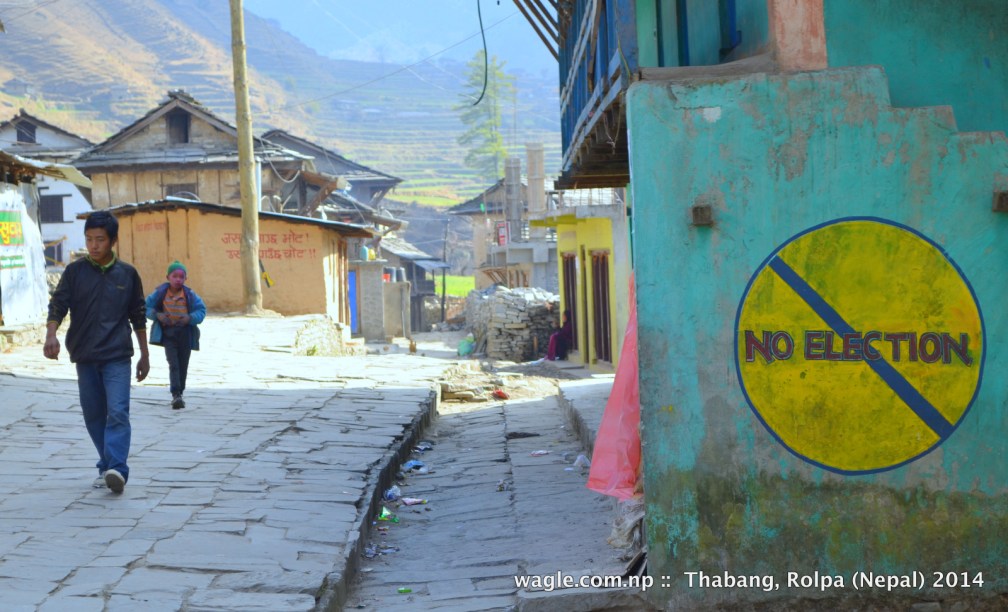
On November 19, 2013 Nepal held national elections for the second Constituent Assembly. The country witnessed a record turnout. I was among the 9.4 million Nepalis who voted that day. But one entire village in remote mid-west Nepal abstained. Thabang boycotted the elections.
One more reason to go to Thabang, I thought.
My desire to go there predated the village’s post-election “fame”. In 2011, I was just five-hours hike away from Thabang. There was a hill between me and the village. That, after walking for three days. But an unexpected and severe knee pain had forced me to abandon my plan.
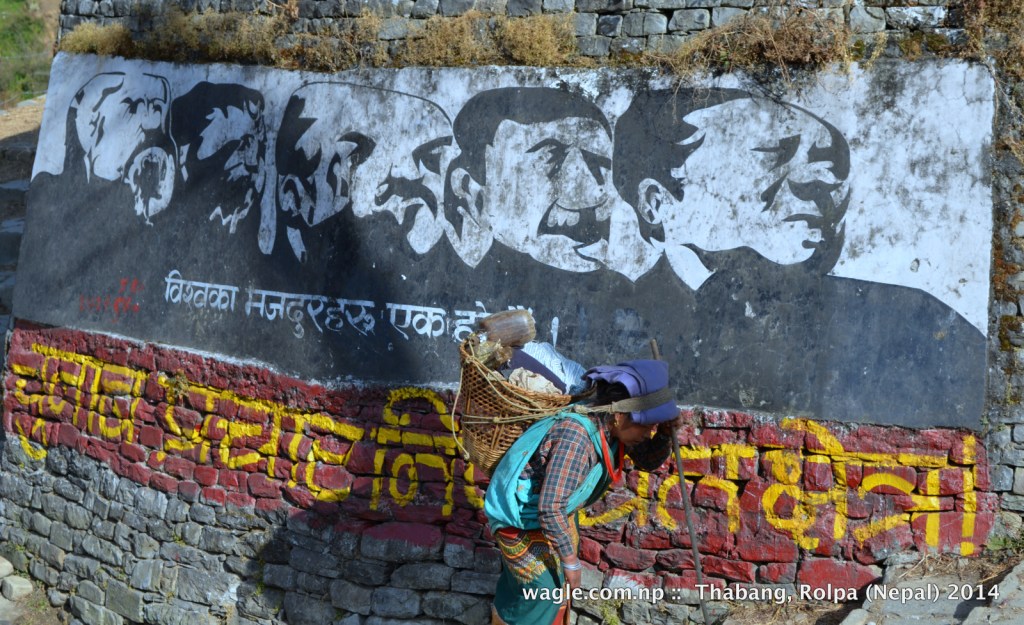
Thabang is where, it is said, the Maoist “People’s War” began in 1996. That’s where some of the top leaders of the insurgency found shelter as they planned more attacks against the Nepali state. “The local people would compete among themselves to host party Chairman Prachanda (Pushpa Kamal Dahal),” Durgalal KC writes in the Kathmandu Post.
The Maoists decided to end their 10-year-long janayuddha in late 2005.The conflict actually ended in 2006 following the spectacular success of the peaceful multiparty mass demonstrations in April that year.
During the insurgency, the Maoists had tried to develop Thabang as “a model Maoist village”. After the end of the conflict, the elected Maoist-led government recognized it as one of a few dozen model villages in the country. This ensured more attention and state funding to the village. To cut the long story short, Thabang is not just another sleepy Nepali village (at least in description). It knows how to take risk and grab national attention at the same time.
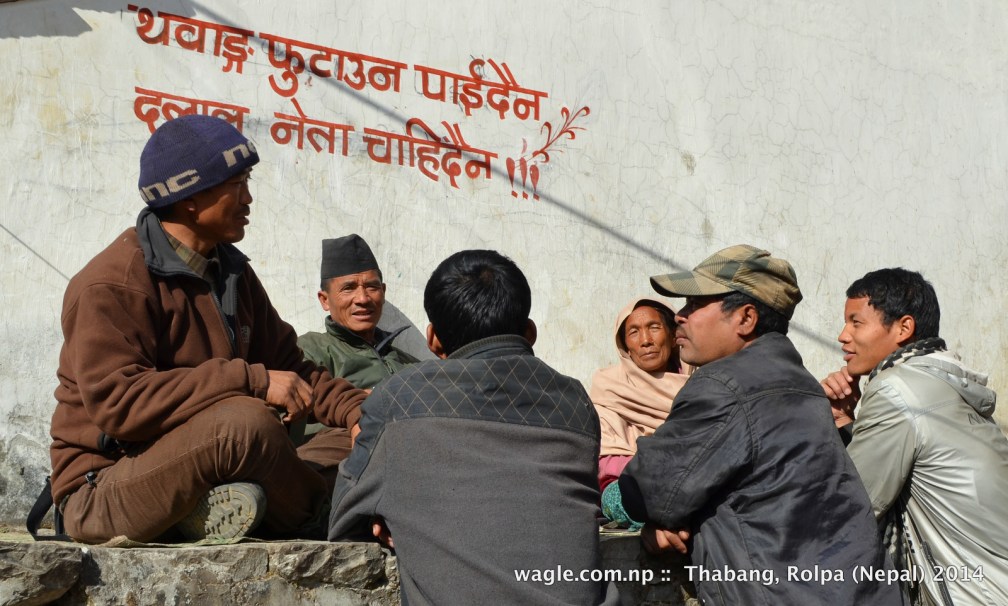
Smash the ballot box- Boycott the election. Thabang, Rolpa.No ElectionIn a recent sunny afternoon the people of Thabang, Rolpa gathered to chat under a Maoist anti-election graffiti. 1st line: Don’t divide Thabang; 2nd line: Middlemen leaders are not needed.Former Maoist guerrilla Jeet Bahadur Gharti and his mules pass through a landslide in Rukum
On that October day in 2011, I stared at the hill that the locals said I would have to climb to reach Thabang. It looked like a tough climb. My knee was not up for it. So I limped with a mule caravan to reach Rukumkot to catch a jeep. (Limping all day long with a mule caravan to reach Rukumkot).
My wish to see the guerrilla village remained unfulfilled.