Like everyone else, I knew it was coming. But I didn’t know when. I had no idea about its magnitude. It’s devastating impact. That’s because, like a generation before me, I had not experienced a strong earthquake. Like most Nepalis, I wasn’t prepared for it. Also, no one can predict an earthquake. So why think about it when you never know when it will strike.
My go-bag (given to me) was gathering dust somewhere in a corner of my house. I wasn’t sure that I would find time to grab the bag before running out in the event of a quake. Would I be even at home? As it turned out, I was several kilometers away from my house when the earth shook violently on 25th April (12 Baishak 2072). Instead of a go-bag, I had in my hands a bundle of investigative newspaper articles that were to be judged for a competition. I was in a teashop that was fortunately only a meter away from an empty road.

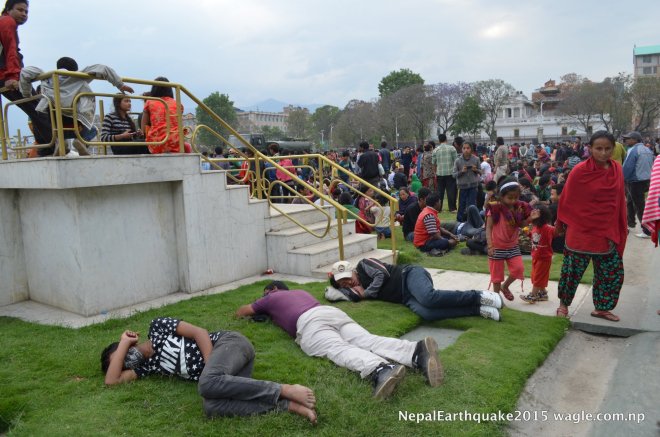
What I remember of those 40 seconds is a strange noise. The sound of structures colliding or something to that effect. I was struggling to stand upright in the middle of a blacktopped road. It was as if I had suddenly found myself in a small boat in rough seas. A woman nearby started to cry. Her husband held her. She continued to scream. A group of people gathered on the road. A few of us tried to console her. By the time the earth had stopped shaking, the people around me had been thoroughly shaken.
One of the first things that came to my mind during the first few seconds into the quake was to be aware of the buildings around me. The building that housed the teashop looked particularly threatening. At one point I thought it would collapse. But it didn’t, like many concrete buildings in Kathmandu. A pleasant surprise. There are many explanations floating around for this. The epicenter was too far. The earthquake wasn’t shallow enough. Houses were built strongly. My own observation is that we were just too lucky this time around.
Immediately after the quake I rode across the city. Except for some old houses with load bearing walls and heritage buildings I saw that most residential concrete houses had survived. The perimeter walls of several landmark buildings had crumbled over hundreds of motorcycles that had been parked by the walls. The collapse of the compound walls of the Nepal Police headquarters, the Prime Minister’s official residence and the Narayanhitti Palace Museum looked particularly astounding. But, by and large, Kathmandu had remained intact at the first glance. Later in the day, reports of substantial damage to recently built high-rise apartment buildings started to come in. As people regained composure, they also noticed cracks, small and big, in their still standing concrete houses. (धेरै…)
![चन्दनपुर गाउँ [Chandanpur Village]](https://wagle.com.np/wp-content/uploads/2014/08/grandma-finds-a-louse-in-her-granddaughters-head.jpg?w=927)


 दिनेश वाग्ले