Latest stories – पछिल्ला टिप्पणीहरू

  • Watching a Nepali Movie: An Experience

    And the experience was horrible.

    arunima lamsal with mom n dad

    Actress Arunima Lamsal in a premiere show of her sixth movie Abhimanyu in a Kathmandu theater on Friday, 5 Jan. Pics by Bikas Rauniar

    Two days ago, I watched a Nepali movie called Abhimanyu (name of a character in ancient epic Mahabharat who falls into a spiral and is killed by enemies). It was kind of compulsion to go to the theater and see the ‘action and comedy drama’. As a reporter you have to face such situations. People in film fraternity always lament: Why Kantipur is not covering Nepali films? As the coordinator of the arts and style section of the paper, I have to handle such complains. After I got invitation to attend the premiere show of the movie in Kathmandu, I decided to watch the film and, if possible, write something about it.

    If you compare Nepali films with Hollywood and Bollywood movies, you will find the former completely avoidable. Produced with comparatively low budget, Nepali films are poor in quality and other benchmarks. An average Nepali film’s standard budget is around Rs. 4.5 million (slightly more than US $ 55 thousands). Don’t compare our films with Hollywood and Bollywood flicks, Nepali film makers constantly warn reporters and other critics. Keep in mind, they say, Nepali film industry and its market is limited. “We are a very small industry and only lower class people watch our films,” said a Nepali film director recently.

    Whatever they say, you can’t stop yourself from comparing. First, the theater (Shiv Darshan in New Baneshwor) was a mess. It was a disaster. How can you enjoy a cinema in such a dirty theater? Chairs were filthy and broken. Somehow I managed to get seated in one of those. They were kept in such a congested manner that I had to remain either straight or leaning forward all the time. If I leaned back, my knees wouldn’t get enough space and push the seat in front of me. Walls are dirty and torn out.

    There are only three or four good cinema halls in Kathmandu where you find relatively good environment to watch cinemas. For example, Kumari and Jai Nepal are the most sophisticated and clean theaters in Kathmandu. Rests are like this one.

    As soon as the movie Abhimanyu ran on the screen people started hooting sarcastically. Credit lines were displayed in reverse. “Oh saala negative po dekhayo,” someone screamed from behind. Then the screen went blank for a few minutes.

    naresh poudyal director of abhimanyu Naresh Paudyal is the director of Abhimanyu Just in front of me was a lady with, I guessed, her daughter on her left and her husband on the right. It took me no time to realize that the ‘daughter’ was the actress of the movie: Arunima Lamsal. As the film got rolled, the family started talking. I was more interested in overhearing their chats and whispers than seeing the movie. Father and mother kept asking “where is this?” almost every time the location changed on the screen. Sometime they laughed on the comedy scenes. My impression is that father wanted to encourage his daughter who was playing in her sixth movie. Father, Bikarm Sharma is an auditor, I would learn later and mother Radha Lamsal was a TV actress.

    The crowd in the theater was a disaster too. Folks were talking loud and every time the hero came to rescue his girl or kicked the villain, they would scream ‘ho, ho, ho’ and ‘ha, ha, ha’ and clap. Mobile phones were constantly ringing and chaps were talking in loud voice: hall ma chhu ma, film heri ra ko chhu. [I am in the theater watching a movie.] Oh… the conversation wouldn’t end on that note. It would be extended; the caller would laugh loudly responding to the person on the other side. You can’t hear the dialogue of the film properly.

    The film sounds so unnatural, at least to me. It’s a paradox that people love to relate a work of fiction with reality they live in. I could easily see the research part of the movie was super flop. Do people use full and formal sentences all the time in their daily and casual conversation? I don’t and no one in my house or office does so.

    Documentaries and non fiction films are gaining popularity in urban Nepal market recently compared to feature films. But the director of Abhimanyu, Naresh Paudyal, had a different argument. “We make films for mainstream audience,” he said, “not for the pseudo-intellectuals of Kathmandu city.” So that was his answer for the rising popularity of non fiction films in Kathmandu. He said the audience of such creations was very limited.

    The show was over and oh boy it was a big relief. Why did I stay in the theater for the whole show? Because I saw story for my newspaper in the family conversation! I wanted to take their photo and talk to the parent of the actress Arunima Lamsal. That’s what I did and made a story.

    [Here is the story that was published in yesterday’s Kantipur daily]

  • Oh My Sleeping Child the World is so Wild

    … But youve build your own paradise

    Every midnight I quietly go to bed with this promise that I will wake up early in the morning. The alarm in my cell phone rings just in time: 6 AM. I instinctively reach up to the machine and kill the sound of Christmas tune only to go back to sleep. I don’t forget the promise made a few hours ago but I can’t open my eyes however hard I try. Okay, I will sleep for a few minutes, I tell myself, and definitely wake up. When I wake up, it’s already 8 AM. Still my eyes find it difficult to get accustomed with the surroundings. They want me to close the lids. I, poor fellow, defenselessly abide by their wish. When I wake up it’s 9 AM or 10 or 11. It could be 12 as well. Early to bed and early to rise. Who said that? I can’t sleep before 12. Even if I try to lie on the bed and get some sleep, I can’t. So I end up dreaming about going on the moon or jumping over from flying jet.

    There are options to avoid such adventures. Take a book or press the remote control buttons. I don’t know which I do the most but I lie on the bed making sure that I am damn tired, or sleepy so that I can’t think of anything weird. Sometime I keep the TV on and try to sleep. Let me say BBC World is informing me about the world events as I am struggling to go way temporarily from the planet. I wake up in the middle of the night, may be at 2 or 3 AM and switch off the idiot box and go back to sleep. This time, I go asleep without even knowing where I am sleeping.

    Over the past five days, I have seen some progress in my effort to wake up early. Five days ago, it was 12 mid day. Then 11. Then 10. Yesterday it was 9. Today it was 8. Quite a feat in waking up early, I told myself and started turning pages of Kantipur. Plus, I was shipping tea too. Bhauju had almost stopped brining in tea to my room for obvious reasons. She would bring tea at around 7 and I would say, okay I am awakening, please put that there. When I was awake, it was 10 or so and tea was icy cold. So she must have thought that I wasn’t’ qualified enough for morning tea.

    So what I want is to go bed early, that is around 11 PM and wake up at around 5 AM. I am sure that is possible but don’t know why my eyes don’t believe me.

    Previous blog on sleeping:

    1. House Arrest: Read, Sleep and Imagine

  • Final Day and Visit to Elephant Breeding Center

    I had an opportunity to have Tharu food in a stall on the ground. The food, Chicheri was similar to rice and was tasty. “What’s your name?” I asked the girl on my left for this caption. “Lina,” she said. And surname? “Come on,” she replied. “You are in a Tharu food stall.” Lina Chaudhari is a student of BA in a college in Chitwan and she was volunteering in the stall. Pic by Pawan Neupane

    28 Dec: The final day of the elephant race. I slept till 3 PM. I read a few pages of The Story of Nobody. I wasn’t feeling well. Subrat Acharya SMSed me saying that the program was about to get over. I was planning to interview the winning elephant rider so I went slowly to the ground. I found an oxen cart on way and jumped over it for the bumpy ride. One guy came after a while and started conversation in broken English thinking that I was a foreigner. Many people have mistaken before. How can a bearded man carrying camera and wearing North Face jacket and trekking trouser be Nepali? I didn’t speak because I knew he was form a hotel or something and wanted me to book room there. When I responded in Nepali to Santosh Acharya, another friend of mine in Nepal Magazine, who was returning from the ground, the boy instantly realized that I wasn’t exactly the one he was looking for. He quickly left the cart but thankfully paid the fare.

    I reached at the ground and interviewed (pic, above by Subrat Acharya) the man of the moment: Nasir Ali seated at the back of the elephant of the moment (Janga Bahadur). Here is what I wrote for Kantipur based on the interview:

    यति कुरा गरिसकेपछि नासिरको दिमागमा हात्तीको कानमा हुने रहस्य फुत्त आएजस्तो भयो । ‘मान्नुस हात्तीको कान भनेको गाडीको एक्सिलेटर जस्तै हो,’ क्लोजअप मञ्जनको विज्ञापनमा देखिनेजस्ता सेता दात देखाउदै नासिर अलिले भने- ‘जति दबायो उति दौडिन्छ ।’

    तर कुनै हात्ती कम र कुनै छिटो किन – निश्चिय नै, त्यो हात्तीको शरीर र बलमा भर पर्ने कुरा हो तर नासिरले फट्ट जवाफ दिए- ‘हजुर उसो त (मोटरसाइकलहरू) स्प्लेन्डर र आरएक्समा पनि फरक हुन्छ । स्प्लेन्डर अलि छिटो दौडिन्छ ।’ लौ, कुरैकुरामा जंगबहादुरको रेकर्ड उल्लेख गर्न बिर्सको । उसलाई तीनसय मिटर जान र सोही बाटो फर्किन फाइनलमा एक मिनेट ३७ दशमलव ३३ सेकेन्ड लागेको थियो । उसलाई दोस्रो हुने पवनकली (एक मिनेट ३७ दशमलव ९७ सेकेन्ड) बाट चर्को दबाब परेको थियो ।

    Here is the complete article.

    Then we went to Elephant Breeding Center, a few kilometers from the ground. I had been there several years ago which I have already mentioned: with Roberto in 1998. That was quite nostalgic crossing over the muddy river in a boat packed with people. I took a video of the center. Here is the video from the elephant breeding center:

    While returning, I bough a bottle of honey. “Hone from tori,” the man said. “How can honey be made from tori?” I asked. Never heard of honey from flower. “Well sir,” the honey is definitely from bees. But bees collected juices from tori. So its tori honey.” I was like wow and instantly paid Rs. 150.

    No evening walk for dinner this evening. In the Unique resort folks started singing and dancing as Pawan and I stayed inside reading and sleeping. He was sleeping and I was turning the pages in the dim light of the hotel room. Subrat Acharya came to invite us to join the entertainment and I reluctantly went outside with him. Wasn’t really feeling well but couldn’t really reject his request as well. We outside and ate a piece of roasted chicken. That was warm and tasty.

  • Elephants of Nepal: Available in All Sizes and Shapes

    Wagle Street Journal Photo and Video Blog
    Images and video from International Elephant Race in Chitwan, Nepal.

    elephants of all size on dispaly in Chitwan, Nepal

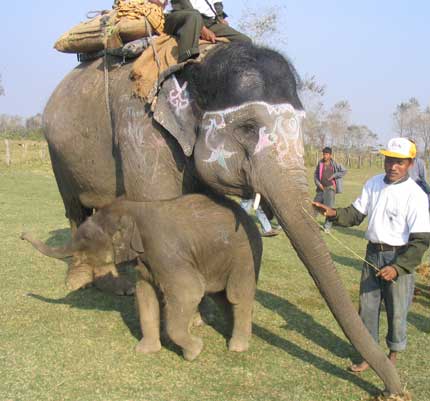
    Pick up your favorite. Elephants of all sizes were on display just before the International Elephant Race kicked off in Sauraha, Chitwan (Nepal).

    elephant with mother

    Protected by his mom, a Chhawa (phuchhe elephant) enjoys the sun and human crowd.

    elephant with mother

    Small is beautiful: Even among Elephants

    elephant with mother

    He was constantly interacting with curious humans who surrounded him as if he was a monkey.

    A video of Elephant Race

    In this video taken on the first day of the International Elephant Race in Chitwan, Nepal I have captured the performance of an elephant called Janga Bahadur. Janga Bahadur becomes first in the preliminary round. He also happens to be the winner of the competition covering the distance of 600 meters (two way distance with 300 each) in 1.37.33 minute. There was a tough challenge from Pawan Kali that became second finishing the race in 1.37.97 minute. Here is more in Nepali.

  • Elephants, Singers and Mahute

    old elephant rider chitwan nepal

    This Mahute, an employee of Hattisar in Chitwan, shred his experience of riding elephants for forty years. His would carry kings of Nepal in the jungle on his elephants.

    27 Dec: I wasn’t feeling well from morning. Pawan Neupane and I went to interview an old man who had ridden elephants of Chitwan National Park for more than 40 years. He shared his experience of riding elephants that were carrying king Mahendra and Birendra. After checking emails in a cyber cafe (Rs. 35 for 30 minutes) at the chowk, I came back to hotel and stayed inside the room reading book and, what else, sleeping. I loved sleeping that day.

    In the evening, Pawan and I visited the Hattisar owned by Chitwan National Park and talked to employees there about their life with elephants and how it was taking care of elephants. Conversations couldn’t be in detail as it was getting dark and time for them, the people, to eat.

    With a glass of whisky (Royal Stag) in his hand, Milan Lama (middle) sings as Madal and guitar give him company.

    We returned to the hotel and headed towards Bagar where we were scheduled to have dinner in a river side restaurant. We met a local folk singer (Keshav Pande’s friend, of course) who had made it big nationally recently with his melody “Majhi dai Pokhara Phewa taal…” and guess what, Keshav Pandey started the duet with him. Milan Lama, the singer, was in another table, about 20 meters far, but that didn’t stop Pande from starting the musical conversation. Milan Lama, who had gone to Sauraha to sing in the cultural program organized on the sidelines of the elephant race, responded. After a while, not being able to deny countless requests from Pande and company, Lama came to our place and the duet got intensified. The singer realized that he that he was now surrounded by journalists and he was excited to sing more and more songs. Every dialogue was delivered in rhythm.

    I was too tired to talk to people (I wasn’t feeling well) and I headed to the hotel without waiting for others after we had dinner. I started reading Chekhov after comfortably resting on the bed covered by the blanket.

  • International Elephant Race in Nepal (Chitwan)

    Blogmandu: My conversation with the winner of the elephant race is here.

    school kids rally elephant race

    Rhinos overshadowed the Elephant race: The public concern about the illegal poaching of Rhinos in Chitwan National Park overshadowed the international elephant race. People were carrying placards, like these students, demanding life for Rhinos. Rhinos here are being killed by poachers almost every month.

    school kids rally elephant race and demand life for rhinos

    26 December 2006: The formal program began in Sauraha, tourist district in Chitwan. Third International Elephant Race was formally inaugurated. Instead of listening to tiring speeches delivered in the opening ceremony, I went to the other side of the large ground and enjoyed the company of more than two dozen elephants. They were all set to give us glimpse of the race that would begin next day. I had never seen assembly of elephants bigger like that before. Elephants of all sizes were there. Small is beautiful even among elephants, I found. A Chhawa was moving here and there playing with humans as her mother was attentively watching his activities.

    tharu cultural rally in chitwan

    Tharu women take part in the rally organized on the opening day of International Elephant Race in their traditional outfits.

    girls with traditional tharu mud pots posing for camera

    Two city girls pose with traditional Tharu mud pots

    It was damn hot and the heat was slowly killing me. The program ended and we headed for Paradise Lodge for tea and a briefing by an FNCCI Narayanghadh official on the upcoming Chitwan Festival 2007. He presented his ideas of promoting internal tourism in Chitwan. People are full of ideas but whenever time comes for execution, they look towards the government. This has become our standard tendency in Nepal. The guy was no different. He was full of complains about government not helping enough in the development of Sauraha. He didn’t talk about what he was doing on his personal capacity to development the area.

    elephants ready for race

    Need any caption?

    I came back to hotel and gave an interview to Radio Sagarmatha on blogging. Deepak Aryal, the host, asked me about the technology and how can people blog. Talking about blogging is one of the easiest topics and I tried my best to answer his questions in the 10-minute-long conversation. The interview, he said, would be broadcast next day. Unfortunately, Radio Sagarmatha is not available in Chitwan and I couldn’t listen to the broadcast.

    elephants ready for race.jpg

    Elephants kneel down so that participants of the elephant race could climb on their back.

    Dinner was in Gainda Wild Life Resort inside the national park jungle. There I met a few familiar faces. Surendra Phuyal, a reporter with BBC Nepali Service was holidaying. Biplov Prateek, a poet and journalist was with his Indian friend. Pawan and I drank juice where as other were enjoying whisky or something. The aura was entertaining. Some guys were cracking jokes and others were laughing. After dinner, we returned with Keshav Pande on the driver’s seat. He was more into singing folk songs than driving. The jeep was dancing on the road in the tunes of Pande’s songs. Occasionally, he would remove hands from the steering wheel and hammer them on the door to produce the music for his songs. No accident occurred during the trip.

    elephants ready for race

    Get, Set, Elephant! Ready for the race

    We came to Hermitage hotel and there too people sang and danced. I wanted to go back to hotel and sleep. I pressed Keshav Pande to return to the hotel but some people, other than our team, insisted that we stayed there for a few songs and dance sequences. There was nothing I could do so I quietly witnessed the ‘celebrations’ standing under a tree nearby. At one point I thought I wasn’t being interactive enough with the team members. It was true that I wasn’t feeling like singing and dancing because, first, I wasn’t feeling really well and, second, the whole atmosphere didn’t really click me.

    elephants ready for race

    There, as I was unwillingly listening to the songs, I felt that I don’t enjoy being in the crowd of people but cherish the company of a computer. I regret that I didn’t carry my laptop there. That would have proved really handy and I could have written more about the tour and the program. Without computer it’s like you don’t have pen and paper to write. I have been reading this kind of report in New York Times and other publications that people are increasingly loosing their interest in real people and enjoying themselves with machines and the virtual world of the Internet. Am I becoming another such character?

    The news of curfew in Nepaljung was particularly shocking because I wasn’t in Kathmandu to grasp all the dynamics of the serious development. “Why all the important things happen when I am not in Kathmandu?” I kept asking myself. That day, I wanted to be in Kathmandu, in the news room. I though of returning to the capital next day but abandoned the idea as nothing worst happened in the city. I hate communal division but my reportorial instinct was that the Nepaljung incident would spread around the country. Fortunately, it didn’t happen and I stayed in Chitwan.

  • हात्ती दौडमा गैंडा चिन्ता

    nasir ali elephant rider with janga bahadur

    नासिर अलि आफ्नो हात्ती जंगबहादुरका दाह्रा समाउदै मख्ख

    दिनेश वाग्ले
    वाग्ले स्ट्रिट जर्नल (चितवनमा)

    जंगबहादुर नामको हात्तीमा सवार नासिर अली त्यो क्षँण कुनै युद्धमा नयाँ राज्य जितेका नबाबभन्दा कम थिएनन् । ‘मेरो हात्ती सधैं फस्ट भएको छ’, गत सप्ताहान्तमा सौराहा, चितवनको एउटा ठूलो मैदानमा आयोजित हात्ती दौड प्रतियोगितामा प्रथम भएको जनावर चढेर चौरबाट बाहिरिँदै गर्दा भैरहवाका २४ वर्षे फनित (माहुतेभन्दा एक तहमाथि) ले मन खोलेर जंगबहादुरको बखान गरे । अरू प्रतिस्पर्धीका तुलनामा केही सानो उक्त हात्तीले फाइनल जित्नु अगाडिका चरणहरूमा आफूलाई पहिलो स्थानमा राखेको थियो । जंगबहादुर र नासिरको पहिलो सहभागिता भए पनि चितवनमा यसखाले प्रतियोगिता हुनथालेको यो तेस्रोपटक हो ।

    धन्यवाद पिप्ले, चितवनका नवराज पन्तलाई जसले दुइ वर्षगाडि कोरियामा देखेका हात्तीको समूहबाट प्रेरित भएपछि स्थानीय होटल सञ्चालकहरूलाई हात्ती दौडको आयोजना गरेर सौराहाको पर्यटन प्रबर्द्धन गर्न सुझाएका थिए । ‘उहाँको कुरा सुनेपछि हामीले छलफल गर्यौं’, हात्ती दौड प्रतियोगिताका संयोजक हरिभक्त घिमिरेले भने- ‘क्रिसमस र नयाँ वर्षो बीचमा पर्यटक निकै कम हुनेहुँदा त्यतिबेलै दौड गर्ने निर्णय गर्यौं ।’ अर्थात् आयोजक क्षेत्रीय होटल संघको मुख्य उद्देश्य दौडका नाममा चितवनका होटलमा पर्यटक, सकेसम्म विदेशी जम्मा गर्नु हो । उद्देश्य पूरा हुँदै गरेको लक्षण होटलका कोठाहरूमा देखिएका छन्- दौडका बेलामा पर्यटक संख्या बढेको छ । दौड नहुँदा, घिमिरेका अनुसार, यही समयमा सौराहाका होटलहरूमा पाहुना संख्या ‘शून्य नै हुन्थ्यो ।’ ‘अहिले तेस्रो मुलुकका विदेशी सयभन्दा बढी छन्’, उनले भने- ‘उनीहरूमध्ये धेरैजसो दौड हेर्नकै लागि बसेका या आएका हुन् ।’ कुराकानी सुनिरहेका अर्का होटल व्यवसायीले दौडकै मौकामा सयौं भारतीयहरू सौराहा आएको बताए ।

    विश्वमै पहिलो दाबी गरिएको हात्ती दौडलाई ‘अन्तर्राष्ट्रिय’ भनिए पनि जनावरहरू नै विदेशबाट ल्याइनेचाहिँ होइन । (तर सौराहामा निजी रूपमा पालिएका थुप्रै हात्ती भारतबाट भाडामा ल्याइएका हुन् ।) दौडमा सहभागी हुन चाहनेले आयोजकलाई निश्चित रकम (विदेशीले दुइ सय डलर र नेपालीले १० हजार रुपैयाँ) तिर्नुपर्छ । चितवन राष्ट्रिय निकुञ्जबाट पाँच र अन्य पालनकर्ताहरूबाट मागिएका हात्तीलाई प्रतियोगीले गोलाप्रथा मार्फ छान्छन् । एकजना विदेशी स्टुआर्ट सिन्क्लेयरले आफूलाई ‘नेपालकै सबैभन्दा ढिलो दौडिने हात्ती’ परे पनि दौडमा सहभागिता रोमाञ्चक रहेको बताए । यसपालि २४ वटा हात्ती सामेल थिए, जसमध्ये ८ वटामाथि स्टुआर्टजस्तै विदेशी चढेका थिए । दौडिने हात्तीमाथि माहुते र प्रतिस्पर्धी व्यक्ति गरी दुइजना हुन्छन् । (रोयल स्ट्यागको विज्ञापनयुक्त ब्यानर लगाएर दौडमा उत्रिएको जंगबहादुर माथि नासिरबाहेक हिमालयन डिस्टिलरीका गोपाल पुरी थिए ।)

    मानिसहरूको दौडमा जस्तै हात्ती दौडमा पनि केही नियम हुन्छन्, जसलाई हात्ती, माहुते र प्रतियोगीले मान्नर्ुपर्छ । सीधा ३ सय मिटर लामो र १० मिटर चौडा ट्रयाकमा दौडिएका बेला हात्तीलाई लठ्ठीले पिट्न या घोच्न पाइँदैन । ‘आपत्कालीनबाहेक सामान्य अवस्थामा हात्तीलाई नियन्त्रण गर्न अंकुशको प्रयोग गर्न पाइँदैन’, प्रतियोगिताको वेब साइटमा उल्लेख छ । त्यसो भए प्रथम हुने हात्तीमा त्यस्तो खासियत थियो ? यही आउँछ, माहुतेको कला ।

    ‘सबैकुरा खुट्टामा भर्रपर्छ,’ जंगबहादुरलाई खुट्टा खुम्च्याउन लगाएर चौरमै बसाए पनि आफू भुइमा नओर्लिइ सवाददातासँग कुरा गर्न थालेका नासिरले भने । उनी हात्तीका हैन, आफ्ना खुट्टाका कुरा गरिरहेका थिए । ‘जति छिटो ठेल्यो, त्यति छिटो दौडिन्छ,’ उनले भने । अर्थात, हात्तीका कानपछाडि माहुतेका खुट्टा घच्घच्याउने । जताबाट घचेट्यो, हात्ती त्यसको विपरीततिर लाग्छ । कानमा त्यस्तो के छ माहुतेका खुट्टाले अगाडि धकेल्नासाथ हात्ती दौडियोस् ? त्यो नासिरलाई थाहा छैन तर उनी भन्छन्- ‘तागतले धकेल्नर्ुपर्छ । खुट्टै थाक्छन् ।’

    ‘साइकल चलाउदाभन्दा बढी जोडले धकेल्नुपर्छ ?’

    ‘हो, बढी । दुख्न पनि बढी नै दुख्छ ।’ यतिन्जेलसम्ममा हात्तीलाई उठाएर आफू भुइमा ओर्लेका फनितले थपे- ‘सास फेर्न गाह्रो पर्छ । मुख बाउनुपर्छ ।’ उनी हात्तीको हैन, अझै आफ्नै कुरा गरिरहेका थिए ।

    जंगबहादुर प्रथम भएबापत नासिरलाई १५ सय रुपैया पुरस्कार मिल्यो भने डिस्टीलरीबाट २५ सय पाएको उनले बताए । छोराको जीत मनाउन नासिरका बाबु चौरमा उपस्थित थिए । नासिरका बाबु र दाजुहरू पनि हात्ती चलाउछन् । १० बर्षगाडि हात्ती चढ्न थालेका नासिरले यसअघि उनले जंगबहादुरकी आमा सुन्दरकली चलाएको बताए ।

    यति कुरा गरिसकेपछि नासिरको दिमागमा हात्तीको कानमा हुने रहस्य फुत्त आएजस्तो भयो । ‘मान्नुस हात्तीको कान भनेको गाडीको एक्सिलेटर जस्तै हो,’ क्लोजअप मञ्जनको विज्ञापनमा देखिनेजस्ता सेता दात देखाउदै उनले भने- ‘जति दबायो उति दौडिन्छ ।’

    तर कुनै हात्ती कम र कुनै छिटो किन – निश्चिय नै, त्यो हात्तीको शरीर र बलमा भर पर्ने कुरा हो तर नासिरले फट्ट जवाफ दिए- ‘हजुर उसो त (मोटरसाइकलहरू) स्प्लेन्डर र आरएक्समा पनि फरक हुन्छ । स्प्लेन्डर अलि छिटो दौडिन्छ ।’ लौ, कुरैकुरामा जंगबहादुरको रेकर्ड उल्लेख गर्न बिर्सको । उसलाई तीनसय मिटर जान र सोही बाटो फर्किन फाइनलमा एक मिनेट ३७ दशमलव ३३ सेकेन्ड लागेको थियो । उसलाई दोस्रो हुने पवनकली (एक मिनेट ३७ दशमलव ९७ सेकेन्ड) बाट चर्को दबाब परेको थियो ।

    nasir ali father with elephant

    छोराको खुशीयालीमा सामेल हुन नासिर अलिका बाबु प्रतियोतितास्थलमा पुगेका थिए ।

    दौड हात्तीहरूको भए पनि प्रतियोगितालाई चौरभन्दा पर जंगलमा अबैध सिकारबाट आफूहरूलाई बचाउन संर्घषरत गैडाहरूले छाँयामा पारे । केही समययता चितवनका जंगलमा गैंडाहरू मारिने क्रम बढ्दो छ जसले विश्वका जनावरप्रेमीहरूलाई जस्तै सौराहाबासी र व्यवसायीलाई चिन्तित तुल्याएको छ । त्यसैले उद्घाटनको दिन देखिएका प्लेकार्ड र गरिएका भाषणहरूमा गैंडाले मुख्य स्थान पाए । उद्घाटन र्यालीमा सहभागी स्थानीय माउन्ट भ्यु स्कुलमा चार कक्षाकी पूजा तिवारीले बोकेको प्लेकार्डले ‘उस्तै प्राणी उस्तै पीडा, मिलेर जोगाऊ एक सिंगे गैंडा’ भन्ने अनुरोध गरेको थियो । दौडकै अवसरमा आयोजना गरिएको सांस्कृतिक कार्यक्रममा गाउन गएका चितवनका मिलन लामा (जसले ‘माझी दाइ पोखरा फेवाताल’ गीतमार्फ राष्ट्रिय ख्याति पाएका छन्) ले यस्तो गीत बनाएका थिए- ‘गैंडा मार्या समाचारले जिउ भतक्कै गल्ने/गैंडा नै हो मूल आधार जिउ ज्यान पाल्ने ।’

    यसोभन्दा मिलन लामाले ठ्याक्कै नासिर अलिको भावना बोलिदिएका छन् । जंगबहादुरलाई चौरमा दौडाउने बर्षमा एक पटक न हो, बाँकी समय उनले सौराहा पुग्ने पर्यटकलाई हात्तीको ढाडमा राखेर चितवन राष्ट्रिय निकुञ्जको जंगलमा गैंडा देखाउनै लैजाने हो ।

    दौड’bout थप चित्र र विवरण वाग्ले स्ट्रिट जर्नलमा छन् ।

  • On Way to Chitwan. Singing and Clapping

    After reaching in Shora Khutte in a cab from Tinkune, we boarded a packed micro bus from Sohra Khutte. Pawan Neupane of the Kathmandu Post, Nabaraj Wagle, part time photographer of Kantipur Publications, Santosh Acharya of Nepal Magazine and myself (Dinesh Wagle of Kantipur daily) were in the initial group. We met a few other reporters, including Subrat Acharya of Saptahik who was coordinating the arrival of journalists, there in Shora Khutte and left for Chitwan at about 3 PM.

    Keshav Pande, as Sharada of Radio Sagarmatha would declare later, was indeed “the Man of the Series.” He sang countless folk and duet songs and danced in bus and dinner tables.

    Soon guys started singing duets and antaksharis and it took me no time to conclude that Keshav Pande, the man responsible for taking the group of journalists to Chitwan, was a folk master. Someone must have done a unforgivable crime by making Kehsav Pande a hotel entrepreneur. He is born to be a lok gayak. He possessed this capacity of turning anything into a song. Elephants screamed from his cell phone as he had set the sound of the animal as the ring tone. Huarrrrrrrr… Sorry, forget the exact sound. Anyway, I tried reading the Chekhov book (The Story Of A Nobody) but it was difficult to concentrate in front of Keshav Pande’s continuous entertainment. His folk songs using English words were hilarious. I liked his spirit and frankness though I later I sensed that he was singing more and doing his duty of providing us information about the event less. I reluctantly took part in antakshari and clapping and suggested a few songs to my group. (In antakshari, you sing songs starting from the last letter of the sentence of the song sang by your opponents.)

    a gaine, traditional Nepali singer, in Malekhu of Dhading district

    A gaine, traditional Nepali singer, trying to earn his living by entertaining customers of a fish shop in Malekhu

    We stopped for machha in Malekhu, the town famous for fish, and enjoyed the music of a gandarva while chewing fish and potato chops. Jokes cracked by Narayan Bhandari of HBC FM made us burst into laughter. “Aru kehi palna sakiyena, yeti ta palnai paryo ni,” was his reply when someone asked about his beards. [I could raise nothing so putting these beards.] That’s my favorite dialogue in the whole trip. I am sporting thick beards these days and I will fire the same line to anyone who talks about my beards. Later, when he saw me he said, “Good to meet you who have beards.” He was one of the most interesting characters I encountered in the trip though he didn’t spend time with us as he was staying in different hotel with separate group.

    The musical tour ended as we reached Sauraha and stayed in Unique Wild Resort. Keshav Pande is the sales director of the resort, if I remember correctly what was printed in his visiting card, and he almost demonstrated his salesmanship by offering one room to four reporters! There were two beds (one double and one single) and he said that he would manage another bed on the floor for the fourth member. “You guys want to enjoy the trip, don’t you?” was his argument! Pissed off by his idea I instantly clarified that we were not there to share bed and sleep on the floor. Pawan and I shared the room as Nabaraj and Santosh shared another.

  • नेपाली चेली’bout अमेरिकी उपन्यास

    patricia mccormick is the writer of book SOLD that talks about women trafficking in Nepal and India

    दिनेश वाग्ले
    बाग्ले स्ट्रिट जर्नल

    काठमाडौं- ‘वेश्यालयमा के हुँदैछ भन्ने बुझ्न सबैले यो किताब पढ्नुपर्छ,’ विश्वको प्रमुख पुस्तक विक्रेता वेबसाइट ‘अम्याजन डट कम’ मा एक किशोरीले लेखेकी छिन्- ‘धेरै बालबालिकाका लागि पराइ लाग्ने विषय समेटेको भए पनि यो आँखा खुलाउने खालको छ र पढ्नबाट नानीहरूलाई रोक्नु हुँदैन ।’

    बेचिएकी एउटी नेपाली किशोरीको कथामा आधारित उपन्यास ‘सोल्ड‘ को समीक्षा हो त्यो । चार महिनाअघि प्रकाशित पुस्तकमा अमेरिकी लेखिका प्याट्रिसिया मक्कोर्मिक (तस्बिरमा)ले आफ्ना सौतेला बाबुबाट भारतको कोलकाताको वेश्यालय पुर्‍याइएकी लक्ष्मीको कथा उतारेकी छन् । प्याट्रिसियाले त्यो लेख्नुअघि नेपाल आएर महिला बेचबिखन’bout अनुसन्धान गरेकी थिइन् ।

    भेष बदलेर वेश्यालयका गतिविधि क्यामेरामा कैद गरिरहेका एक फोटोग्राफरसँगको पाँच वर्षअघिको जम्काभेटपछि प्याट्रिसियाले एक जना केटीको दृष्टिकोणबाट त्यो हृदयविदारक कथा भन्ने निर्णय गरेकी थिइन् । ‘(अमेरिकी) युवाले अन्ततिरका उनीहरूकै समवयीहरूलाई के भइरहेछ भन्ने थाहा पाउनुपर्छ,’ न्युयोर्क टाइम्स र रिडर्स डाइजेस्टमा लेख्ने पत्रकार प्याट्रिसियाले एउटा अन्तर्वार्तामा भनेकी छन्- ‘गत वर्ष महिला बेचबिखन’bout मिडियामा केही रिपोर्ट आए तर तिनमा गहिरो चित्रण थिएन । मेरा लागि एउटा पुस्तकजति शक्तिशाली र स्थायी प्रभाव अरू केहीको हुँदैन ।’

    न्युयोर्कमा पति, छोरा र दुई बिरालासँग बस्ने आफ्नो वेबसाइटमा उल्लेख गरेकी प्याट्रिसिया सम्भवतः अमेरिकामा नेपाली समस्या चिनाउने अभियानमा सफलोन्मुख छन् । केही साताअघि ‘नेसनल बुक अवार्डस’ को अन्तिम सूचीमा मनोनीत भएको पुस्तक अहिलले निकै चर्चित भएको छ । ‘लक्ष्मी बेचिएको कोलकाते वेश्यालय (ह्याप्पिनेस हाउस) ‘मसला, खाने तेल, अत्तर र चुरोटको धूवाँ’ मा रुमल्लिएजस्तै प्याट्रिसियाको उपन्यासले पनि थुप्रै बासना बोकेको छ,’ टाइम म्यागेजिनले यसपालि लेखेको छ- ‘कुनै प्रेमयुक्त छन् त कुनै हृदयविदारक । उपन्यास पाठकहरूले समय खर्चिनयोग्य छ ।’

    अनि ‘अम्याजन डट कम’ को समीक्षा पृष्ठमा ती किशोरी लेख्छिन्- ‘पुस्तक पढेपछि लक्ष्मी (१३ वर्षे) लाई के भयो होला भन्ने कल्पनाले मेरो मथिंगल उडाइदियो र म चिच्याएँ । किताबले मलाई बदल्यो र मेरो उमेर पनि लक्ष्मीकै जस्तो छ ।’

    SOLD is the story by patricia mccormick of 13 year old Laxmi, a Nepali girl, who was trafficked to an Indian brothel

    आख्यान भए पनि आफ्नो पुस्तकलाई आधिकारिक तुल्याउन वास्तविक घटना अनुसन्धान गर्ने प्याट्रिसियाको बानी हो । ‘सोल्ड’ की मुख्य पात्र लक्ष्मीलाई पछ्याउँदै को लकाताको रेडलाइट क्षेत्र पुग्नुअघि काठमाडौंमा रहँदा प्याट्रिसियाले चेलिबेटी बेच्ने अपराधीहरूलाई जेलभित्र अन्तर्वार्ता गरेकी थिइन् । ‘अनुसन्धानका क्रममा निराश हुनबाट आफैंलाई बचाउनु चुनौती भयो,’ निजी वेबसाइटमा प्रकाशित अन्तर्वार्तामा उनले भनेकी छन्- ‘वेश्यालयमा केटीहरूले भोगेको पीडा कस्तो थियो भने अमेरिका फर्केका कयौं दिनसम्म म निराश भइरहें । ती केटीहरूको कथालाई न्याय गर्न सक्दिनँ कि भन्ने सोच्थें । वेश्यालयका केटीहरू बिरामी या मरेपछि नयाँ केटी त्यहाँ पुर्‍याइन्छ भन्ने सोच्दा जतिसक्दो चाँडो उनीहरूको कथा विश्वसामु पुर्‍याउने आवश्यकता महसुस गरें । अनि किताब लेख्न थालें ।’

    उनले बेचबिखन रोक्न आफ्नोतर्फबाट योगदान पुर्‍याउन पाठकसँग आह्वान पनि गरेकी छन् । ‘स्कुलमा समूह बनाउनुस्, बेचबिखन’bout फिल्म देखाउनुस्, पैसा उठाउनुस्,’ अर्को अन्तर्वार्तामा लेखिकाले भनेकी छन्- ‘बेचबिखन हुने देशहरूको जीवनस्तर निम्न छ र तपाईंहरूको एक साताको खर्चले वेश्यालयमा रहेका केटीहरूको ठूलै आवश्यकता पूर्ति गर्न सक्छ ।’

    पुस्तक ‘एउटा दृश्य एकपटक’ वर्णन गर्ने कवितात्मक शैलीमा मुख्य पात्र लक्ष्मीको दृष्टिकोणबाट लेखिएको छ । एउटा दृश्यलाई ‘हिसाबकिताब’ नाम दिइएको छ, जसमा लक्ष्मी वेश्यालयमा आम्दानीको हिसाबकिताब गर्दै आफू फुत्किने सपना साँचिरहेकी हुन्छिन् । बिछ्यौनामुनि लुकाएको नोटबुकमा उनले गरेको गणितप्रति संगीनी साहन्ना आशावादी छैनन् । आम्दानी कति न्यून छ भने खान्की, बिछ्यौना र गर्भ रोक्ने सुईका लागि तिरेपछि बाँकी केही रहँदैन ।

    ‘यो हिसाबकिताबदेखि भने वेश्यालयकी बाई मुम्ताजले तँलाई जिउँदै गाड्छे,’ साहन्नाले उनलाई सतर्क तुल्याउँछिन् । फेरि केहीछिन जोडघटाउ गरेपछि लक्ष्मी आफैंसँग भन्छिन्- ‘म अहिल्यै जिउँदै गाडिइसकेकी छु ।’

  • Ready to Enjoy Elephant Race in Chitwan

    I think I have mentioned it already, don’t know where and when though, that work and fun come hand in hand for me. Work is fun and fun is work. Even when I am in stress, while writing stories, I try to enjoy. I feel like man you love this job, don’t you? If you love, why be overwhelmed by the pressure. Don’t buckle down under pressure. Be cool, think hot and decide and do accordingly. When deadline is approaching and you have finished only two (out of possible 5 paragraphs story), you feel the pressure. When you have to edit another story (sometime a badly written one) after finishing writing yours, you feel the heat. But to be calm in such moment is what a reporter needs to do. This much of lecture for the time being. I was about to talk about fun in the job.

    Tomorrow, I will be going to Chitwan National Park (Sauraha) to report an event: Elephant race. Isn’t that exciting? I wanted to write more about the event here but I don’t have the paper now and I am not that bright to remember all the stuffs that I read a week ago. But there are some things that you hardly forget. I was in Sauraha years ago (1998) and the only thing I remember is sitting atop an elephant and roaming around the jungle. Rhinos were hanging around. Past several weeks have been disappointing as I have been reading news of rhinos being killed one after another.

    So the elephant race must be exciting. I will have to file stories for my newspaper so evenings will not be all fun (though I might say that writing news is also fun!) This is one such special situation reporters find themselves in. They enjoy the game (any game like football or cricket) like all other spectators in the stadium. When the game is over, other spectators go home (or bars) talking about the match. They enjoy. But reporters go to office to work. For reporters, work begins at the same time when others start celebrating! To being a reporter is a kind of celebration in itself! (Afno job ko prasansha ta garnai paryo ni! What’s harm is praising your own job!)

    So I will be celebrating my job and enjoying the Hatti Daud (elephant race) in Sauraha. Just remembered, its Christmas time. Timing is not bad too!

    On Books By the way, I had said in this blog that I would be writing my impression of the book that I was reading last week: Kafka on the Shore. That was a good read though occasionally that gave me the impression that I was reading a work of pornography. Some of the scenes were graphic but at times the writer discusses on philosophical and world issues that makes the not just another pulp fiction.

    From today, I have starting reading “The Story of a Nobody” by Anton Chekhov. This is my second attempt to read the book. A few months ago, I read the book up to somewhere in the middle and stopped turning pages. Not that it’s dull but just felt like not continuing with reading it. This time it’s slightly different. I have started enjoying it. First few pages are full of great lines. Here I quote a few of them:

    “I wanted peace of mind, health, good air, a full stomach. I was becoming a dreamer and, like a dreamer, did not know what it actually was that I needed. At times I wanted to retreat to a monastery, sit there for days on end by a window and gaze at the trees and fields; at other times I imagined myself buying a few acres of land and living like a country squire; at other I swore to myself that I would take up academic work and without fail become a professor at some provincial university.”

    Exactly my sentiment. I have decided to take this book along with me in Chitwan trip. I hope to find time to read most of the pages if not all.

    By the way, here is yet another line from the book:

    “Tell me what you read, they say, and I will tell you who you are. That may be so, but to judge anything about Orlov from the books he read is absolutely impossible. It was just a mishmash.”

    I have no comment on this.