As seen from inside a moving train. That’s my hand
It’s 1:7 am, and as it happens with me most of the nights, I am awake. It’s not because of insomnia though. I am tapping this entry from the upper berth of the train Kerala Express that must be running somewhere in Madhya Pradesh right now. After having dinner at around 8 pm, I had slept at 9. When I woke up at 12 midnight, I thought it was already morning. I was thinking too much. (धेरै…)
The Bharatiya Janata Party of India has realized that its hard-line brand of Hindutva politics doesn’t work anymore. And that’s a good news thanks to its defeat in the parliamentary polls
“There’s a fire raging in BJP,” said a headline in India the previous week. After the humiliating loss in the recently held parliamentary elections, the top leadership of the Bharatiya Janata Party that propagates the idea of Hindutva has been involved in internal wrangling, blame game, finger pointing and leg pulling. The party, like all losers, has been trying to figure out the cause behind the unexpected wallop in the national polls that gave the rival Congress party an opportunity to continue in government with enhanced authority. (धेरै…)
What? A trip to Taj Mahal, Agra.
When? Saturday, June 13
How? I was lying on my back on the ground of Lodhi Garden Friday evening hoping to count a few dozens stars. Then this idea of going to Taj Mahal struck me. (Pics from last month at LG: One,Two,Three.) I had gone there with Satish. He started lecture about where can trains can take me in India. He also tried to convince me against driving to places like Mathura or Agra (as opposed to train journeys) arguing that I was still not “acclimatized” with Indian roads and traffic system. It was already 8 PM and was decided on that auspicious hour that we leave for Agra in less than 10 hours. I woke up even before the alarm clock that was set for 5 am performed its duty. I think that was the earliest in years. My usual wake up time is around 9 am while 7 am or 8 am are generally early hours for me to get out of bed. I woke up, took shower, put new clothes and was ready for the day. Then I called Satish only to hear from his mother that he has gone back to sleeping after he was woken up at 4 am. I was determined to make the trip happen. So I moved out of home, towards the nearby Nizamuddin railway station to catch a train to Tajmahal, Agra. The Taj Express was scheduled to leave the station at 7:15 am. (धेरै…)
On his chin, Anand sports a Lenin-cut beard and a compromise. He wanted to be a bearded man, perhaps like Marx, but his girlfriend hated that. Thus the compromise.
Occasionally, the compromise is breached. This past week, Anand didn’t get time to trim his beard. The young Indian who left Delhi last Monday (15 June) aiming to reach Nepal spent his days bicycling on the sizzling roads. The juicy updates about the international cycle journey have been popping up in Twitter (@kaargocult) and his website rega.in frequently. “i hve a frnd named gautam who is into chakra meditation. Claims to have power over weathr. I requsted him for clouds n here they r,” says one post, called Tweet, in the micro-blogging site. “Sitting besides ganga watching others washing their sins away.” One guy says, ‘saare paap dhone hain bhen@&od‘ (Have to wash away all the sins, sister @&od).”
After a round of interview in a crowded eatery in Lajpat Nagar, I invited Anand to my apartment where he got a Chandra Surya! [रातो र चन्द्र सूर्य जगी निशान हाम्रो…] (धेरै…)
In New Delhi’s old commercial hub, discontent is brewing over cups of coffee. The caffeine has jumped out of the cafe and reached the court. A civic agency has threatened to close down a 57-year-old coffee house located at the top floor of a shopping complex Mohan Singh Place in Connaught Place for not paying the rent. The patrons are not pleased, and the Indian Coffee Workers Cooperative Society that runs the not-so-commercial hangout has sued the New Delhi Metropolitan Council. The war for coffee guff is being fought on all fronts: cultural, political and judicial.
In this age of air-conditioned cafés with nice seating arrangements, you wouldn’t really fight for the continuity of a coffee house where fans hovering over the stained tables and broken chairs can hardly provide any respite to customers in the scorching summer heat. By the standards of the swanky outlets installed across the city by chains like Barista and Café Coffee Day, the Indian Coffee House is an old and ailing museum where mostly oldies and middle-aged come to kill time by talking all the “nonsense” that comes to their mind. But that is exactly the reason, its patrons argue, for the continuation of the coffee house. Despite its grimy outlook and loathsome service, this is no ordinary coffee house after all. As some protest pamphlets pasted these days on the walls of the Coffee House proclaim, this is a café that has produced prime ministers of India.
“Save the PM-maker Coffee House,” says one placard. “This is the country’s think tank coffee house,” proclaims another. “(It’s an) intellectual hub.”
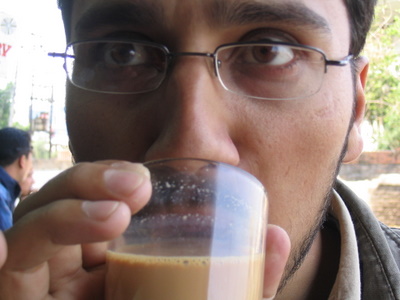
Nostalgia: One of the many things that I miss about my Kathmandu life in Delhi is the tea-shop environment. Having cups of tea and talking whole lot of things in between them was part of the life there, particularly during office hours which sometime would go up to 11 pm from say 10 am. The tea sessions were not pre-planned but spontaneous. ‘Chai wai?’ one of us (either Deepak Adhikari, a journalist with Kantipur, or me) would ask over the IM and then in about 5 minutes we were down on the street, at the back of the office in Tinkune, ordering tea at the chiya pasal. By the time chiya came, we were already engaged in some topics that ranged from, but definitely not limited to, the American politics to Pulitzers to creative writings to some obscure columns in some obscure foreign publications. During the lengthy American election process we named our tea-sessions the Caucuses.
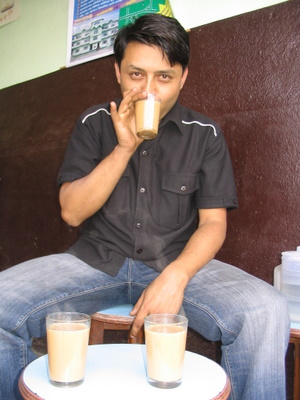
Deepak Adhikari, with three cups of tea, in the photo taken same day
I consider myself a great tea-drinker. At one sitting which might last up to half an hour I could go for as many as three cups of tea. As the guff (a Nepali word for chitchat) started getting more intense with some heated and interesting arguments, another round of tea would be ordered almost automatically, most of the time as a passing thought, without even giving much thought to the tea. As if tea was only a bahana for our talks that were fruitful from various perspectives. Tea would work as a supporting ingredient in our guff.
And the third cup is for Ujjwal Acharya.
It seemed as if the professional life was impossible to live without at least a few cups of tea a day in the teashop just outside the office. Such was the importance of tea in our daily life that once Deepak wrote a full blog entry about the tea and the boy who used to serve us the tea in that particular chiya pasal. That was in late 2005. Countless cups of tea were consumed as we held countless sessions of guffs in the chiya pasals around our office since then. But the desire to drink tea and be engaged in guff is not satisfied yet. [Here is the post that Deepak wrote: Our Cups of Tea. Today, after almost four years, when I read that entry with a grin, I felt like it was written yesterday.]
We needed no more than two stools to seat and, if available, a third one to put our cups was always welcome.
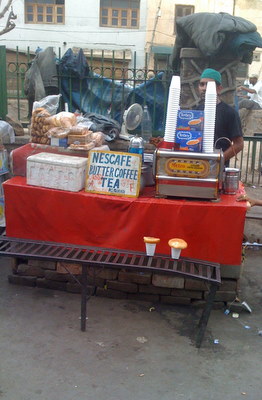
A roadside tea-stall near Nizamuddin Dargah
Reality: Here I am in New Delhi’s Jangpura Extension, where I work and live on the third-floor apartment of House No. B19. There are no tea-shops like those in Tinkune here. One dhaba at the right corner of the block makes MoMo and little bit of tea but there’s no “environment”. No place to seat, no stools. More importantly, there is no tea-partner. A cup of tea without some guff (chitchat) is never enjoyed.
So one day I asked Satish Bhaiya, 56-year-old son of my landlord Uncle Mehra, about the tea-shop atmosphere similar to that available in Tinkune.
I know about the magical tea that they serve in a busy chiya pasal in front of Jama Mosque in Old Delhi. But that’s too far to go in the evenings. [A separate entry will be posted on that chai (Hindi for tea)]
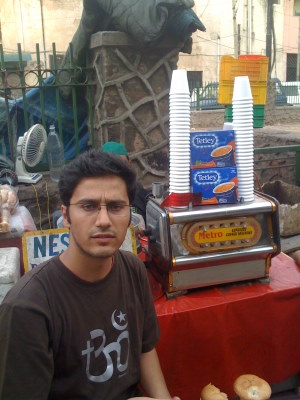
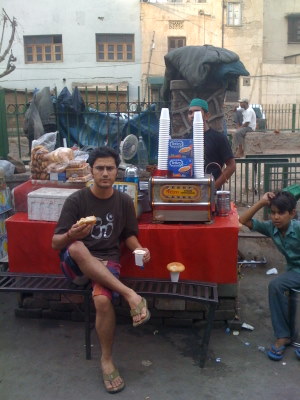
As we were roaming around Nizamuddin Dargah one evening, I kind of found the chiya-pasal I was looking for. On the side of a busy street leading to the dargah (mausoleum) stands a makeshift tea-stall that serves packet-tea and milk in paper cups. We ‘discovered’ that after having a terribly bad malai-chai in a nearby hotel. The best thing about this tea-stall is that it serves good tea and provides a bench to seat so that I can watch the moving crowd of Muslim devotees, cycle-rickshaw wallahs, fruit juice vendors, beggars and other curious passersby while sipping tea. There is some atmosphere. On the opposite side of the tea-stall, I can see, some busy cooks roasting mutton and chicken. A fan that is moving inside a hotel room in which, Satish and I guess, pilgrims from Africa are residing. Apart from occasional gora faces of curious western tourists, the area is filled with African and Arab Muslims who come to see the dargah of Sufi saint Nizamuddin Auliya. The market is lively, busy and it’s quite a task to get unnoticed by the beggars. They start following you until you give either of the two things: a good scold or money. As I am strictly against giving money to beggars and don’t feel scolding is a good way of scaring them, I mostly try to ignore then and, if they continue running after me, give an irritating look. I find it strange that no beggar comes closer to Satish. Perhaps I should change my dress. The place is good for Muslim food. I often buy biryani here. A famous restaurant Karim’s is nearby.
Closeup: in front of a tea stall in Nizamuddin
The neighborhood is distinctly different from other near-by residential areas. As opposed to wide roads and planned settlements like Nizamuddin East or Jangpura Extension, this area, particularly the one surrounding the dargah, has dark, narrow allies and the houses that remind me of Kathmandu’s Ason or Banaras. I have walked inside the neighborhood couple of times and what is seen is completely a different world that what is visible in other parts of Delhi. This part is just like Old Delhi.
Overview
Once I went to see the dargah and found that males from all religions are allowed inside but Muslim women are barred from entering.
That is not of my concern. Mine is limited to the tea. That is why I have been frequenting to the place almost every evening in the past several days for a cup (or sometime two) of chiya.
Democracy in Action: An example of ordinary citizens being able to voice their concerns
By Dinesh Wagle Read the article as it appeared on today’s OP-ED page of the Kathmandu Post
If you wish to see the great Indian democracy in action, go to a place called Jantar Mantar, near the Parliament House in New Delhi, where centuries ago a king had installed some planetary observation platforms. From these observatories today, during the day time, one can see not the stars but people from across India and beyond shouting slogans, rallying and screaming against (or for) the government and institutions and staging sit-ins or fasts advocating varieties of causes and condemning many of the evils in the world. (धेरै…)
A kid, carrying the Indian National Congress Party flag, walks on the street in front of the Congress headquarters in New Delhi on the day of the counting of votes of the month-long parliamentary elections. Congress emerged as the single largest party with more seats than it got in 2004 polls. Pic by Zakaria Zainal
One thing that provides India with the world’s, particularly the West’s, trust and respect is its virtually stable and reasonably functioning democracy. Like in Nepal, votes can still be bought by a glass of drink in many parts of India and millions don’t cast their vote but vote their caste. And many don’t even care about the democratic process. They ask a brutally simple question: “How does it matter to me who wins or loses?” Therein lies a challenge to all democracies all over the globe: indeed, how to attract people to the decision-making process and make it more inclusive? But still democracy in India is a matchless outlet for people to vent their anger, dissatisfaction, frustration and, at the same time, express their desires, aspirations and dreams. (धेरै…)
This is about this guy whom I have been seeing busy at his work all day, almost every day, since I came here to Jangpura Extension, one of south Delhi’s many residential complexes. He is there, right at the front of the building, on the side of the road that is attached to number B-19 whose third floor I live on. It’s been six months, and we have never talked. When leaving my apartment and returning, I see him busy at his work. Freezing cold? He is working. Scorching heat? He is busy. Every time I see him I can’t but appreciate his dedication to work. I am inspired. Look at this guy who is working so hard, standing and in harsh weather. How can you complain or possibly find difficulties in the comfort of a chair and air conditioner? How can you not complete the work that has been pending for a week? (धेरै…)
सुन्नुहोस् मौसमसम्बन्धी समाचार- दुई हजार २५ सय मिटर अग्ला पूर्वी नेपाली पहाडमा जन्मेहुर्केको र साढे १३ सय मिटरमा अवस्थित काठमाडौंमा बढे-पढेको मलाई समुद्री सतहबाट २ सय ३९ मिटरमात्रै अग्लो दिल्लीको गर्मीले आश्चर्यचकित हुनेगरी चेताउनु खासै नौलो कुरो नहुन सक्छ । तर यहाँ चकितपनाले सीमा नाघ्नै लागेको भान हुन्छ । शुक्रबार दिल्लीको तापक्रम अधिकतम ४०/न्यूनतम २८ छ भने, म मेरो आइफोनमा आखाँ ठूला पार्दै हेर्छु, काठमाडौंको २७/१३ छ । दिल्लीको न्यूनतमभन्दा पनि काठमाडौंको अधिकतम कम भएको तथ्य यो चर्को गर्मीमा पिल्सिएको बेला हत्तपत्त पत्याउनै गाह्रो पर्दोरहेछ । सोमबार यहाँ ४४ डिग्री पुग्ने अपेक्षा गरिएको छ भने काठमाडौंमा २९ । (धेरै…)