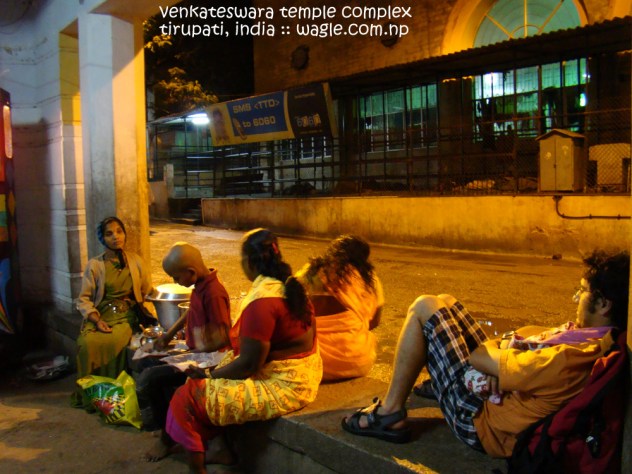
…I spent the rest of the night leaning against a concrete staircase inside a huge hall full of hundreds of people trying to get some sleep. (This pic was taken before I moved in to the hall.)
It was 1 am when I reached Tirupati Balaji temple in Andhra Pradesh. Tired of the long journey from Mahabalipuram via Kanchipuram I was planning to get off the bus and head toward the nearest hotel. God had different plans. I was surprised to see bustling crowds of devotees at that hour of night and shocked to learn that no room was available in the whole of the temple town. I spent the rest of the night along with my co-traveler leaning against a concrete staircase inside a huge hall full of hundreds of people trying to get some sleep. When the day broke we moved towards the temple hoping to get inside for darshan.
The richest temple of the world, formally known as Venkateswara temple, is hidden from the devotees until they pass some barriers. A glimpse of the roof of the temple could be seen from a small hilltop. Devotees wishing to go inside the temple have to pay Indian Rs. 300 so that they could stand in a queue that is supposed to have less people. But that priority queue appeared to be a couple of kilometres long, forget about the regular one that I guessed could have extended several kilometres more. We decided not to go for darshan. (धेरै…)
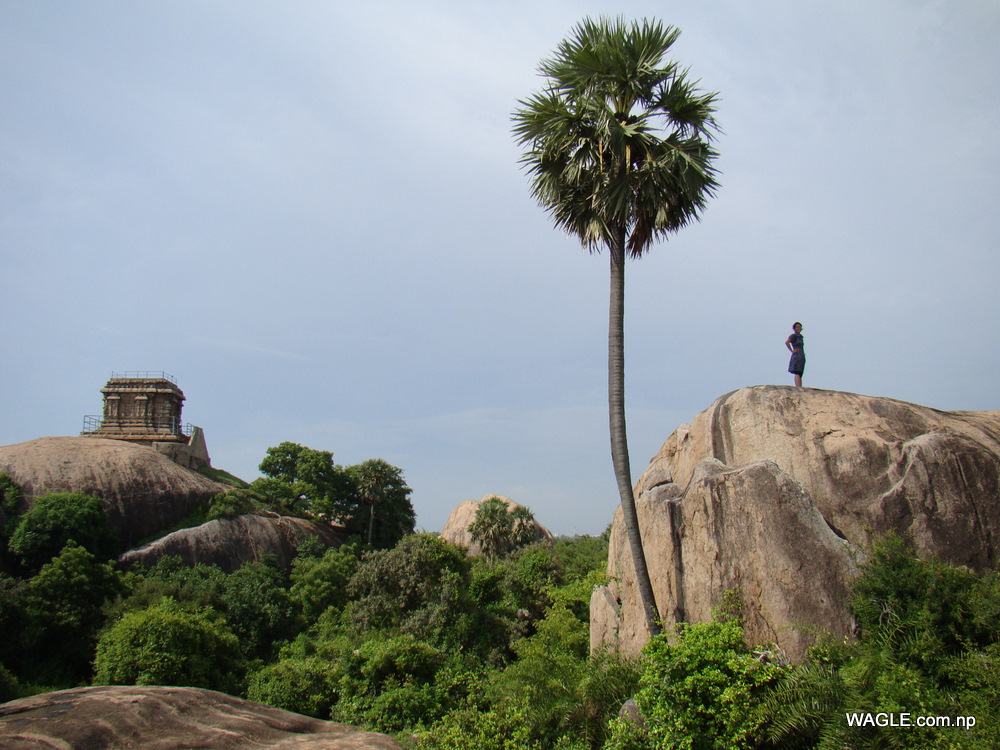
A woman at the top of a rock in Mahabalipuram's World Heritage Site
Mahabalipuram (or Mamallapuram) is one of the most beautiful places I have visited in India in the past two years. The combination of beach and rocks AND the awesome monolithic structures makes the place so special that, by the end of the day, you will realized that a day is simply not enough to explore this historical site. It’s a small town, peaceful and touristy, where centuries old monolithic stone temples and carvings are scattered in walking distance from the beach. It’s barely an hour from Chennai, on way to Pondicherry (two hours from here).
The Shore Temple is a top destination because of its location, right on the shore as its name suggests. The rocky beach in front of the temple saves it from being hit directly by the water but that doesn’t mean the occasional wrath of the sea doesn’t harm it always. Over the centuries parts of temple have been washed away by the water, a book on town says.
The huge complex of rocks and carvings on the other side of the road is where we spent most of the day. The book Mahabalipuram- a journey through a magical land by Srinivaas and J Prabhakar that we had bought in Chennai came very handy while exploring the carvings and rocks. The writers could have done without their occasional ‘witty’ observations about the arts and carvings. The reader is interested in the structure and its historical significance, not the jokes and moral lessons that the writers prefer to draw from them. The research that they have done to prepare the book is commendable. I have used writers’ descriptions of structures and carvings alongside the relevant photos posted below. (धेरै…)
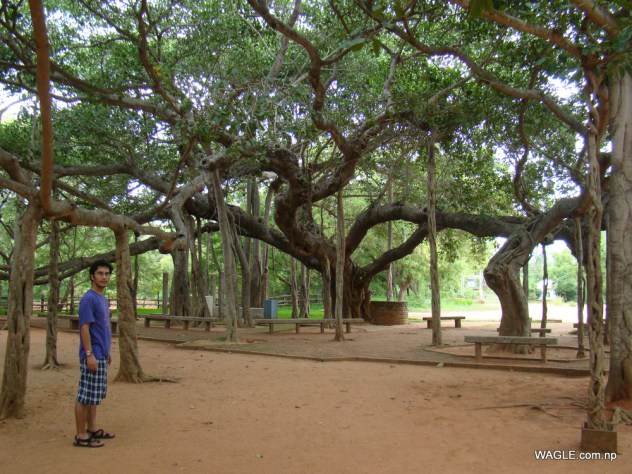
Aerial prop roots have grown into thick woody trunks supporting the banyan tree as it extends laterally. Click on the photo for more info.
I always thought बर (Banyan) was the husband of पीपल (Peepal). It’s not because the word बर also means husband in Nepali :). It’s probably because I have always seen these trees together on चौतारीहरु (chautaris) in villages- mostly on the opposing sides of a chautari. On certain days people go to chautaris or whereever Banyan and Peepal are and “marry” them. They garland both trees- single garland- amidst a ceremony. This should explain the significance that Banyan (बर) along with Peepal holds in Nepali society. Peepal is considered more religous and sacred than Banyan, I believe. Both of these trees are deeply rooted in our culture too. A lot of songs talk about them.
खोला वारी खोला पारी पीपल र बर
हावा चल्यो पात हल्यो माया वर वर -मदनकृष्ण
[Thanks to my significant half who told me about the existence of this particular song.]
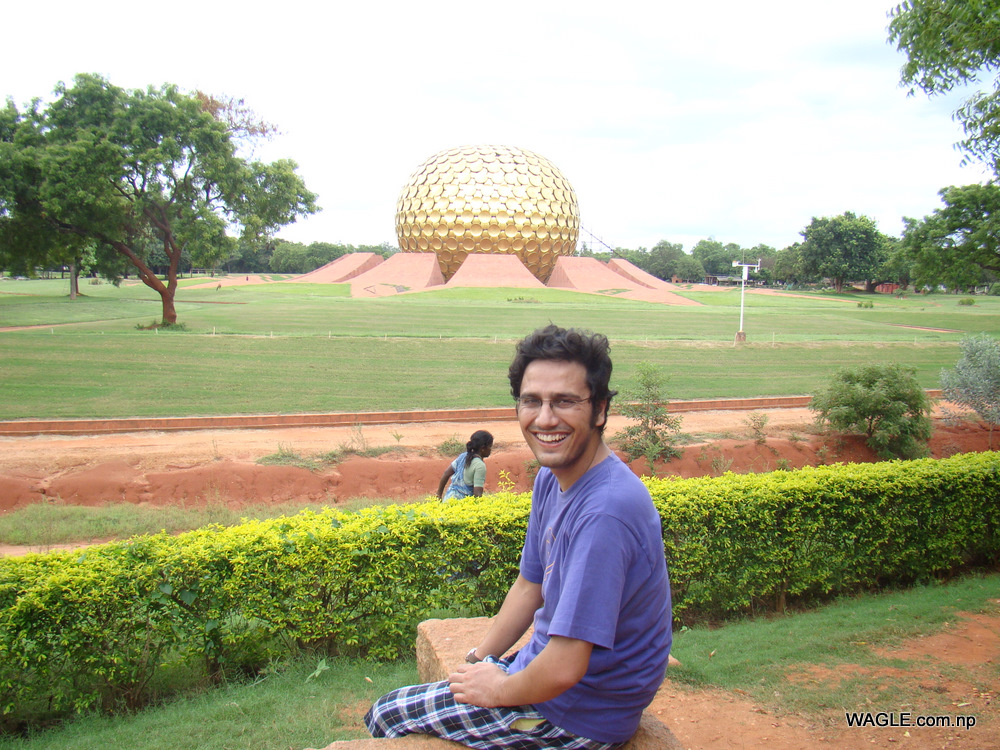
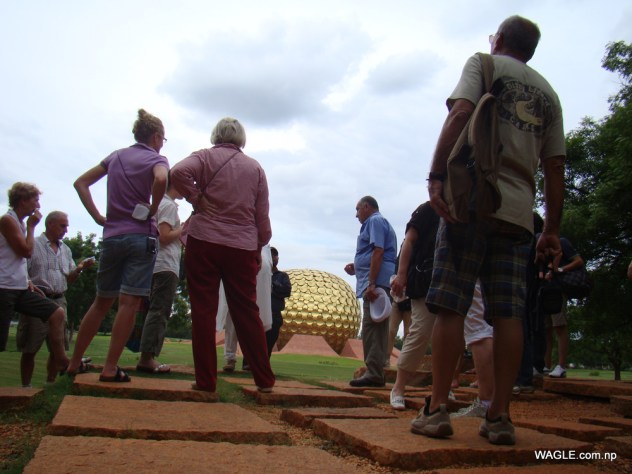
Tourists in front of Matrimandir, Auroville
I remember hanging and swinging on the aerial prop roots of Banyan tree in my childhood. But I had never seen a Banyan tree with APR fully developed into woody trunks before I visited Auroville in Pondicherry last month. An hour ago I also knew that Banyan is the national tree of India. I was completely awed by the sight of this giant banyan tree near Matrimandir. All Indian tourists who were traveling with us and other Westerners we saw at Matrimandir completely ignored the tree and kept walking ahead. We branded them fools for not stopping by the tree and admiring its shape, size and beauty. (धेरै…)
The extreme airport video of Lukla reminded me of an extreme highway in West Nepal on which I have traveled thrice. A documentary (below) on Karnali highway made by a French production company rates the highway as one of the world’s most dangerous. My first journey on the highway that lasted for 52 hours straight was the result of my unwillingness to wait indefinitely at Jumla airport (another not-so-easy-to-land-at airport) for a plane to come from Nepalgunj The weather didn’t improve thus I opted for the road. (Why and How I was in Jumla and where did I go. Plus: Rara Lake and a different Alchemist)
The second time I traveled on the highway, I started the journey from Surkhet as driver Tilak and his helper Muskan (and the Rautes) do in the film. After watching the movie, if you become curious about Tilak Nepali thenTales of a Highway Driver in Karnali is the page to go. It was such a memorable journey but at times I was so very tired too. (Super Tired. Nearly Depleted. Almost Finished) (धेरै…)
Last week Suraj Kunwar forwarded to me a link to a video that documents thrills of flying in and out of Lukla airport of Nepal. The film, made by History Channel, rates Lukla number one in the list of the most extreme airports of the world. The film also contains video footage of 2008 Yeti airline crash at the airport that Suraj had captured almost live. From a reporter’s perspective, he was almost in the right place at the right time. I was pleasantly surprised to spot a familiar face in the film. Arpan Sharma of nepa-laya reports about the airport in the documentary.
Lukla! I have always wanted to go to Khumbu (the Everest region) of which Lukla is considered the gate thanks to the short take-off and landing airport there. Last time I was close to landing at Lukla was in 2005. That didn’t happen because the weather wasn’t good enough for a plane to land at Lukla that day. After making us wait for about six hours at Kathmandu’s airport the airline, Yeti, rescheduled the flight for the next morning. But I canceled the trip that evening because I wanted to be in Kathmandu to witness important political developments (the royal regime attacked Kantipur FM that evening).
While watching the History Channel film on Lukla airport I couldn’t stop thinking about my own desire to go there. But more than that I kept asking one question: Do I really want to fly in to Lukla? It feels so dangerous to take a plane to Lukla when you hear Captain Bijay Lama telling why the airport is so risky to land at. There’s no question of NOT landing once you reach a certain point, he tells. Also the structure of the runway and the notion that you will be landing there scared me. I have landed at several STOL airports in Nepal, some of them without paved runways where cows and buffaloes are seen grazing. At one point, while watching the movie, I felt good that I didn’t fly to Lukla then! (धेरै…)
Pondicherry has one of the oldest (1828) botanical gardens of India.
The British once ruled the Indian subcontinent (except Nepal, of course) that included present day India, Pakistan, Bangladesh and Sri Lanka. But they were not the only foreign powers to rule India. The Portuguese and the French controlled Goa and Pondicherry, located on two opposing coasts of India. Having visited Goa (west coast) twice I always wanted to go to Pondicherry (or Puducherry)- sometimes described as “the French Riviera of the East“.
This slideshow requires JavaScript.
I haven’t been to the French Riviera but didn’t find Puducherry the town up to my (and my co-traveler’s) expectation. We had expected the place to be very calm, without much traffic, touristy, romantic and better than Goa. It is not entirely so. But the rocky beach where French and British once killed each other for the control of Puducherry looked nice- far better than Marina. We spent couple of hours there in the evening after returning from Auroville where golden metallic Matrimandir is the center of attraction. But we found a huge banyan tree nearby far more grander and mesmerizing then the man-made structure. (More about the banyan tree and photos later). The botanical garden near the railway station is a nice place to be for a while though it’s not exactly a garden. It’s kind of an orderly jungle with trees of various kinds. Unfortunately no nameplate could be found attached on all of them. (धेरै…)
How fast time flies! I am here in Marina. The sight of sea fascinates the hilly, landlocked person in me so immensely that the salty water holds inexplicable taste to me. The waves, the sand, the color.
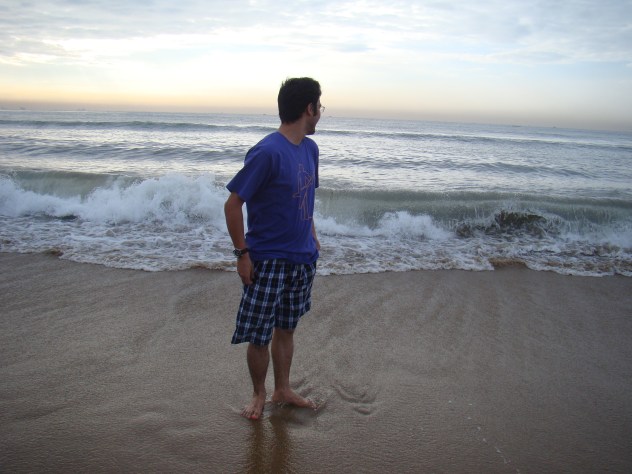
Me, this morning, at Marina beach, Chennai.
I was in Marina last year jumping and running around the beach wearing dhoti and operating a camera. It’s the same Bay of Bengal, the same water (salty!) and the same sand- I believe. The beach, second longest in the world hasn’t changed it’s appearance- like in July 2009 the beach may not make it to the list of 1000 cleanest beaches in the world this year too. Even a dirty beach excites the hilly man in me. (धेरै…)
First the credit. This post is inspired by and based on Tajim’s entry on his website. I have copied his post- including the title- and added my own comments and links where I felt appropriate. So this is more of my extended comment to his post than an original entry. He is 25. I am six years older than him so it’s but natural for me to experience/see more things than he has. But hey here’s no booze around me and I am not drinking while saying “yes I have done this one!”
Goa
Seen an Ocean – [Yea, until 2006 when I saw the Pacific in California. It was an amazing experience. (photo) To see, feel and, yes, taste the sea water. Then in 2008 I saw the Arabian sea in Kovlam, Kerala before seeing the Indian ocean come together in Kanyakumari (and again in 2009) with the Bay of Bengal and the Arabian Sea. In Mumbai the same week, I saw the Arabian sea more closely (and again in 2009). In 2009 I finally saw the Bay of Bengal more closely at Marina Beach, Chennai. Running around on the beach wearing dhoti was quite an experience.]
Been to a swimming pool– [I have been to two swimming pools to swim. 1st in Balaju while I was in school. 2nd in Dasharath stadium, Tripureshwor. That too while I was in school. I haven’t been to one (to swim) since I left school. And that was more than 15 years ago. That doesn’t mean I haven’t swum in these years. I have crossed Likhu Khola and dived into Khimti Khola! नढाटी भन्नु पर्दा पौडी खेल्न चाहि उति सारो आउदैन है । तर फेरी त्यसो भन्दैमा कुनै पोखरीमा कसैगरी झरीएछ भने हत्तपत्त मरिन्न जस्तो पनि लाग्छ । 🙂 ]
Flown Overseas– Not since 2006 when I went to the US. No foreign government has invited me for such trip since then. Invitations are welcome!
Travelled on the roof of a moving bus– PLENTY! While going home in Ramechhap during Dashain holidays in my school years. It was risky as it is now but with risk came with a lot of fun and an opportunity to show how brave you were. Last time I traveled on the roof of a moving bus was, if I remember correctly, in 2008 while going for a trek to Helambu. Very few buses were plying on the road because of Dashain holidays (that was the day of nawami).
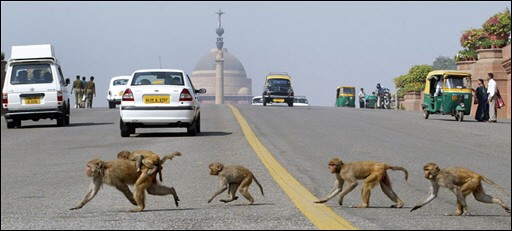
“We are at their mercy,’’ lamented Rajesh Sehgal, a resident of Mayur Vihar Phase II neighbourhood in east Delhi. “The number of monkeys in the locality has increased beyond control in the past couple of years.” Pic by AFP in 2006, Rajpath, New Delhi.
Humans and monkeys struggle for space in the Indian capital
It took me a week and three incidents to identify the culprit. I had kept a bucket of household waste just outside the main entrance of my third-floor apartment so that the collector could take it away. One recent afternoon, the collector knocked on my door to show me something. I was horrified. The waste materials were scattered all over the stairs as if it had been done by a monkey. Or could it be the work of the dog that always sleeps at the main entrance three stories below? I wasn’t sure. But last week, I saw him live in action, playing with my kitchen waste, scattering it all over—like a monkey. The culprit was indeed a monkey.
For the first time in 20 months, I got the taste of living in Delhi. A bad taste it was, but perhaps not so bad compared to what residents of many other neighborhoods in Delhi are experiencing. Monkeys are creating havoc in their daily lives. “We are at their mercy,’’ lamented Rajesh Sehgal, a resident of Mayur Vihar Phase II neighbourhood in east Delhi. Sehgal is also vice president of the area’s Residents Welfare Association. “The number of monkeys in the locality has increased beyond control in the past couple of years,” he told The Times of India last week.
In June, a monkey entered a high security Metro train in Northwest Delhi and delayed the service by 15 minutes. No one was harmed, but members of the Central Industrial Security Force had to intervene to get the monkey out of the train. A cell phone captured the simian’s antics that were fun to watch later on TV, but Metro officials were not amused. “The animal caused a flutter among passengers with everybody running helter-skelter,” NDTV quoted an anonymous Metro official as saying. (धेरै…)
Excerpts of an article published in the Kathmandu Post today:
Despite being so close and sharing a border there is an unimaginably high level of misunderstanding about Nepal among Indians. Some of those misunderstandings are based on rumours and hearsay (all Nepalis smoke pot) while others are created by the Indian mainstream media that is most of the times frighteningly immature and trivial when it comes to covering Nepal.
Tens of thousands of Nepali students study in India—right across the country. They are more likely to meet educated and influential Indians (some with misinformation about Nepal) all over the country. That is why these students, not the diplomats, are the real ambassadors of the Himalayan republic in the world’s largest democracy.
Sometime the arguments turn into unreasonable blabber. “When they have nothing to support their argument, they just try to bring in nationality and say ‘you Nepalon, keep quiet’,” said a student who studies in Delhi University. “In such cases when they just argue nothing but keep repeating about the size of their democracy, we also say: if you are the largest democracy, don’t forget, we are also the highest democracy,” said another student at Jawaharlal Nehru University.
Lesser known or politically and economically less powerful countries try to promote their interests in important foreign societies and markets through various means. But Nepal hasn’t found ways to promote itself among the Indian public.
Only a person with a flat nose and, I hate to use the word here but I must, “chinky” eyes, passes as a Nepali for many Indians…..Going by their reactions and comments, I have come to the conclusion that only those with Mongolian features are considered Nepali in India.
When I hear the same from educated Indians like journalists, software professionals, bank employees and university students, I seriously try to explain to them the diverse nature of Nepali society that lives at different altitudes, eats varieties of foods, speaks many languages and sport different looks.
It was the lunch hour and the concrete shade, not very far from the showroom, was his favorite spot to eat. Not that they didn’t let him eat in a corner of the showroom itself; but, he said, he found peace here. “And some time to rest,” he added. Hundreds of thousands of uneducated, unskilled and unemployed men (and women) from Nepal come to several Indian cities to take up low-wage, laborious and sometimes humiliating jobs. One can find such Nepalis almost everywhere in India.